Gas and Electrical Certificates for the Same Landlord: How a Mixed Trade Firm Keeps CP12s and EICRs on One Property Record (UK, 2026)
Doing the gas and the electrics for the same landlords? Keep each flat's CP12 and EICR on one property record, each with its own due date, recipients and invoice line.

Updated 14 November 2026
TLDR: A firm doing gas and electrical work for the same landlords needs one app that files both trades' documents against the property, not the engineer. Each flat should carry its annual landlord gas safety record and its EICR, each with its own due date, recipients and invoice line, so neither renewal depends on the other team remembering.
The letting agent emails asking for "the certificates" for Flat 2. Your gas engineer sends the landlord gas safety record within the hour. The EICR your electrician did last year sits in a different app on a different phone, so the agent gets half an answer and chases again.
The paperwork lives with the person who did the job rather than with the flat. If you do the gas and the electrics for the same landlords, the useful question is whether one job management app can hold both trades' documents on the same property record, with the right dates and recipients on each.
See how Checker files every CP12 and EICR against the landlord's property, with each engineer on their own login.
What does each trade owe the landlord, and when?
The two documents run on different clocks and go to different people, which is why one list of reminders cannot cover both. In England the landlord gas safety record is annual and the electrical installation condition report is at least five-yearly, and the copies each one needs are not the same.
For gas, regulation 36 of the Gas Safety (Installation and Use) Regulations 1998 requires each appliance and flue in a let property to be checked at intervals of not more than 12 months. The landlord must give existing tenants a copy within 28 days of the check and new tenants a copy before they move in.
For electrics in England, the Electrical Safety Standards in the Private Rented Sector (England) Regulations 2020 require the installation to be inspected and tested at intervals of no more than five years, or sooner if the last report says so. The GOV.UK guide for landlords, updated in 2025 to cover social housing too, sets out who gets a copy:
- the existing tenant, within 28 days of the inspection;
- a new tenant, before they move in;
- the local council, within 7 days of a written request;
- the person who does the next inspection.
Where the report calls for remedial or further investigative work, the landlord has 28 days, or less if the report says so.
| Duty | Landlord gas safety record | EICR (England) |
|---|---|---|
| How often | At least every 12 months | At least every 5 years, or sooner if stated |
| Existing tenant | Copy within 28 days of the check | Copy within 28 days of the inspection |
| Extra recipients | New tenant before move-in | New tenant, council on request, next inspector |
How often
Landlord gas safety record: At least every 12 months
EICR (England): At least every 5 years, or sooner if stated
Existing tenant
Landlord gas safety record: Copy within 28 days of the check
EICR (England): Copy within 28 days of the inspection
Extra recipients
Landlord gas safety record: New tenant before move-in
EICR (England): New tenant, council on request, next inspector
The duty is the landlord's, but the landlord or agent relies on your firm to produce the right document at the right time, so the dates and recipients end up in your system whether you plan for it or not.
Do the rules change in Wales, Scotland or Northern Ireland?
The gas rule is the same across Great Britain, because the 1998 regulations cover England, Scotland and Wales, and Northern Ireland has its own Gas Safety (Installation and Use) Regulations (Northern Ireland) 2004, listed on HSENI's gas page, with the same 12-month check. For electrics, Wales, Scotland and Northern Ireland each set a five-year check through their own rules, and in Wales the contract-holder gets a copy within 14 days. The setup below works in every UK nation: an annual reminder for gas and a separate one for the electrical report.
Why do two systems split one property's paperwork?
Two apps split the paperwork because each one is organised around its own trade's job, not around the flat. The gas app knows the boiler and its annual date, while the electrical app knows the consumer unit and its five-year date, and neither knows the other document exists.
That split shows up at three joins:
- The wrong document goes out. The agent asks for everything on a flat and gets one trade's paperwork, because whoever answered could only see their own app.
- A renewal falls between teams. The gas team books its annual visit and the electrical renewal on the same flat is missed, because it sits on someone else's list.
- The visit is billed twice. Two engineers attend on one day and an agent who wants one bill receives two invoices with two references for one trip.
Better forms in either app fix none of these; only one job management app with a shared property record that both trades write to does.
How do you put both trades on one property record?
Put the landlord in once as the customer, add each flat as its own property, and file every gas and electrical document against the flat it belongs to. Then each document carries its own due date and recipients, and the admin, or anyone you give access to both trades' jobs, can answer the agent by opening one record.
Here is the setup, in the order that saves rework:
- Create the landlord as one customer and each flat as a property. Put the agent's contact on the customer so both trades send to the same address.
- Decide who sees what before anyone joins. Settle whether electricians can see gas jobs on the same property, and lock prices and certificate wording, before you invite staff.
- File each document against the property it belongs to. A CP12 and an EICR for Flat 2 should both appear when you open Flat 2.
- Set a reminder per document, on its own cycle. The gas record needs an annual reminder. The EICR needs one timed to the next inspection date on that report, which may be sooner than five years.
- Record the recipients on each document. Note whether the tenant copy goes from you or the agent, and where the electrical copy for a new tenant has to go.
- Agree the billing with the agent. Ask whether they want one invoice per visit or one per job. If one, raise it with a line for each document and send both reports with it.
Step 4 is the easiest to get wrong. A single annual reminder per property sends the electrician round four years early, while a five-year reminder misses four gas checks.
What does this look like for one landlord over a year?
Here is a worked example with one landlord, three flats and one year, using these assumptions, as at 13 November 2026:
- The firm has four people: the owner and one engineer doing gas, and two electricians.
- The landlord owns three flats managed by one letting agent.
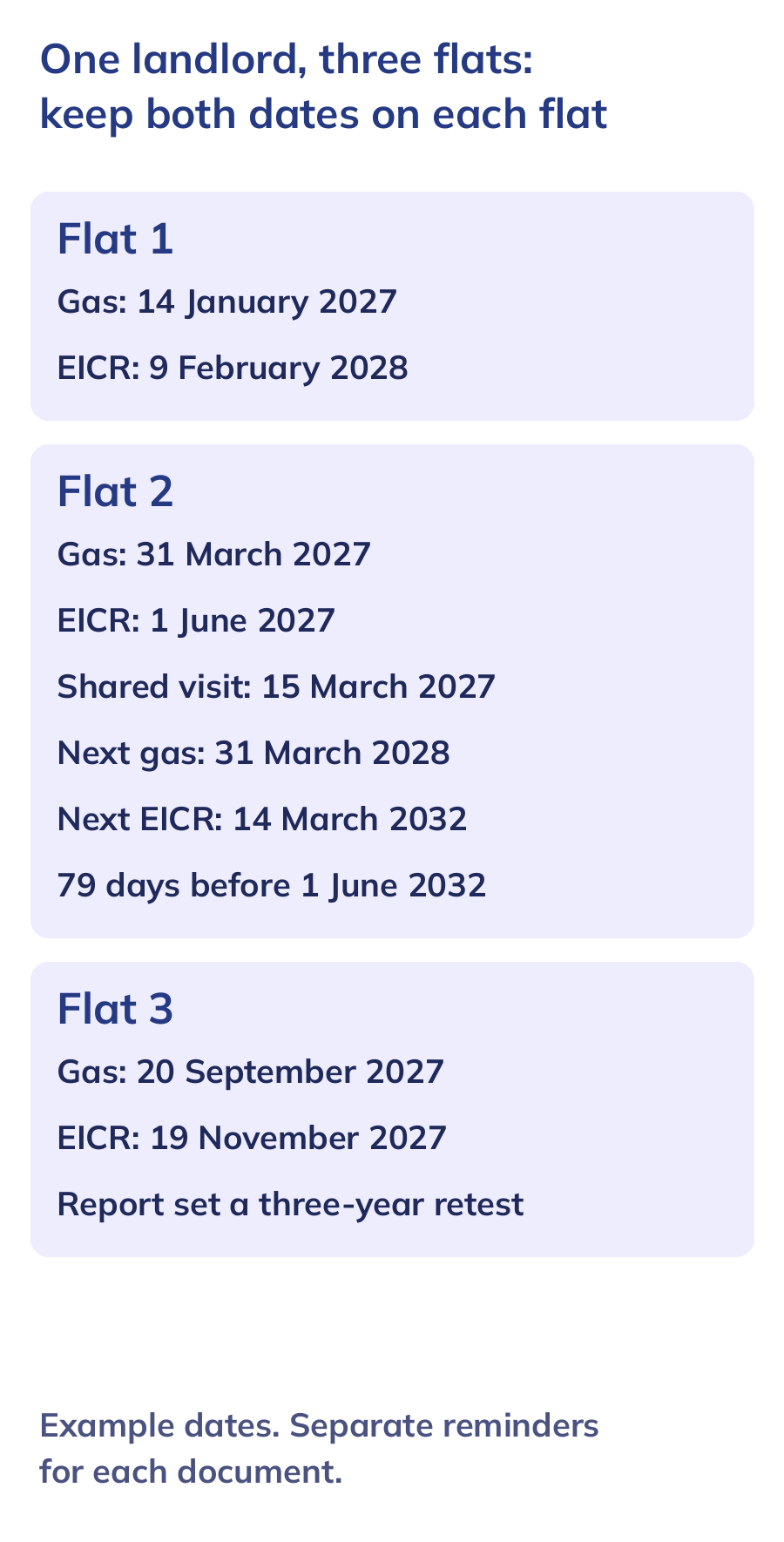
- Flat 1: gas check due by 14 January 2027; EICR due by 9 February 2028.
- Flat 2: gas check due by 31 March 2027; EICR due by 1 June 2027.
- Flat 3: gas check due by 20 September 2027; EICR due by 19 November 2027, because the last report asked for a three-year retest.
The dates are chosen to show how the cycles meet.
In January the gas engineer does Flat 1. Nothing electrical is due, so the record goes to the agent and the reminder rolls on a year.
Flat 2 shows where the two cycles meet. The gas check is due by 31 March and the EICR by 1 June. The office needs two separate reminders on Flat 2’s property record, one for each document and its own due date, before it offers the combined visit. Under regulation 36A, a gas check done in the two months before the deadline keeps the original anniversary, so a visit on 15 March 2027 still leaves the next gas deadline at 31 March 2028. The electrical regulations have no such rule. If the new report permits the five-year interval used in this example, inspecting on 15 March makes the next EICR due by 14 March 2032 instead of 1 June 2032: 79 days of cycle given up for one shared access visit.
That is a fair trade for many landlords, since one key collection and one tenant appointment is worth more than 79 days spread over five years. It is the landlord's call, though, and your firm can only offer it if someone can see both dates on the same flat in February.
On 15 March both teams attend. The agent gets one email with the gas record and the EICR attached, and the invoice goes with them. In September and November, Flat 3 needs a gas visit and an EICR two months apart, and the same view shows whether booking them together is worth it.
Where does Checker fit?
Checker files gas and electrical documents against the landlord's property in one customer record, which is the setup above. Our customer database lets you store one landlord with as many properties as they own, and each property has its own appliance list, document history and service reminders.
From the same job record we produce the Domestic Landlord Gas Safety Record (CP12) and, on the electrical side, the Electrical Installation Certificate, the EICR for supplies up to 100A, the Minor Electrical Installation Works Certificate and related reports. Service reminders cover landlord gas safety records and landlord EICRs. The default is 11 months, and you can change the default and override it on any individual reminder. Before relying on it for a mixed portfolio, test one EICR reminder against the next inspection date on that report. Quotes and invoices let you attach several files to one email, so the reports and the invoice can go together.
For a mixed team, staff management gives each engineer their own login and signature. By default an engineer sees only their own work; the admin can open up the wider diary. The current roles are one admin and engineer sub users, and an office staff role is still in development.
Records and reports are unlimited on every plan, but the customer database and annual service reminders are on PRO (£19.99 a month plus VAT) and PRO+. Extra staff logins need PRO+ at £25.99 a month plus VAT, with each sub user £10.99 a month plus VAT, according to our pricing page on 13 November 2026. For the four-person firm in the example, with the owner as admin and three sub users, that is £58.96 a month plus VAT.
When do two specialist apps still make sense?
Two specialist apps still beat one all-in-one job management app when the trades do not share customers. If your gas team works for homeowners and your electricians work for a commercial contractor, there is no shared property for one record to join up, and you lose little by keeping separate tools.
The same goes for an electrician who only works as a subcontractor and hands every report to the main contractor. And if most of your electrical work is on supplies above 100A, our EICR will not cover it, so a dedicated electrical package is the better tool for that work.
Frequently asked questions
Can one person answer the agent for both trades?
Yes, if both trades file to the same property and that person can see both. In Checker the admin can. An engineer sees only their own jobs unless the admin widens access, and the office staff role is still in development.
Should I send the tenant's copy or leave it to the agent?
Agree it per landlord and write it on the customer, so the record is emailed to the agent, the landlord or the tenant as agreed. The duty to give tenants a copy sits with the landlord. HSE says an engineer may send the gas record direct with the landlord's agreement.
Does a new tenancy need a new EICR?
Not in England, if the last inspection was within five years and any earlier date set in the report has not passed. There must be no outstanding investigative or remedial work. GOV.UK says the landlord gives the new tenant a copy of the current report before they move in.
Can I invoice the gas check and EICR together?
Yes, if the agent wants one bill. Put a line for each document on one invoice and send both reports with it, so the payment matches the visit. Some agents settle each job separately, so ask first.
Does a reminder make the landlord compliant?
No. A reminder prompts the booking. The landlord stays responsible for the checks, the copies and any remedial work.
Put one landlord, three flats and both trades into Checker and keep each flat's certificates and reminders under the one landlord.
Further reading
Authoritative sources
- Gas Safety (Installation and Use) Regulations 1998, regulation 36
- Gas Safety (Installation and Use) Regulations 1998, regulation 36A
- HSE: gas safety check records
- HSE: gas safety checks, what if
- Electrical Safety Standards in the Private Rented Sector (England) Regulations 2020, regulation 3
- GOV.UK: electrical safety standards in the private and social rented sectors, guidance
- Renting Homes (Fitness for Human Habitation) (Wales) Regulations 2022, regulation 6
- Scottish Government: Repairing Standard statutory guidance, electrical installations
- Department for Communities: Electrical Safety Standards for Private Tenancies Regulations (Northern Ireland) 2024
- HSENI: gas safety
- Gas Safety (Installation and Use) Regulations (Northern Ireland) 2004, regulation 36
- Checker customer database: multiple properties per landlord
- Checker annual service reminders
- Checker quotes and invoices
- Checker staff management
- Checker pricing, checked 13 November 2026
- Checker electrical software
- Checker gas engineer software

Certificates, quotes and invoices done on site, then service reminders that bring the work back.
Same app everywhere. We show local paperwork, tax and terms, and remember your choice.