Which gas safety renewal date should you put in the diary when the records disagree?
Settle conflicting gas safety renewal dates with signed records, a clear diary entry and a two-record test before you enable reminders.

TLDR Start with the actual check date on the signed landlord gas safety record. Use a later, preserved deadline only when the landlord can show the records that support it. If the latest check itself is uncertain or the deadline may have passed, raise it with the landlord promptly and arrange or confirm the check.
The landlord emails a spreadsheet with the renewal marked for October. The signed report in the job folder says the engineer checked the boiler in September. Before you move either date into the diary, find out what each one represents. September could be the date the engineer went round and October could be a deadline carried forward from the previous cycle. October could just as easily be a date someone copied across from last year's list.
I’d give the office three separate fields. The check date tells you what happened. The statutory deadline tells you when the next check has to happen. The reminder date tells you when to ring or email to get it booked. You can bring the call forward if it takes a while to get access. The deadline stays where the evidence puts it.
These rules cover landlord gas safety checks in England, Scotland and Wales. Northern Ireland has separate gas safety rules.
Published
Which records settle the disagreement?
Match the signed report to the address, down to the flat number, and to the appliance or flue you’re putting back in the diary. A job completion date, PDF filename or invoice can help you find the report. The report gives you the date the engineer actually did the check. An annual boiler service and a landlord’s gas safety check are separate jobs for record purposes. If the same visit included both, find the record that covers the landlord check. HSE explains what that record must contain, and HSE explains the separate duty to maintain appliances and flues.
- Match the address and equipment. Read the property address, then the description and location of each appliance or flue on the report. If the previous report lists a boiler and a gas fire but the latest one lists only a boiler, ask the landlord or engineer what happened to the fire before giving both the same deadline.
- Record the actual check. Put the check date alongside the report reference and where the signed copy is held. Check the engineer’s name, signature and registration number. Keep the spreadsheet date in a separate field with its source so the person picking this up next knows which date is in dispute.
- Trace the previous deadline. If the landlord says they kept an existing deadline by checking early, ask for the two previous gas safety records and the dates showing how that deadline was carried forward. Compare the latest actual check date with the final two calendar months ending on that evidenced deadline.
- Record the decision and owner. Write down the date you can support, the records it comes from, who checked them and when. Give any open question to a named person in the office with a follow-up time. Once the deadline is settled, add the booking reminder as a separate date.
Use one row per appliance or flue where dates differ. A single property reminder can be set early enough to cover the first due item, provided the office still knows which dates apply to the other items. That way the landlord can book one visit without losing sight of why it needs to happen by that date.
| Field | What to enter |
|---|---|
| Property and equipment | Address, flat, appliance or flue, and location |
| Latest check | Actual date, signed record reference and file location |
| Earlier evidence | Previous report references, actual dates and deadline carried forward, if applicable |
| Date in dispute | Date supplied, who supplied it and where it came from |
| Decision | Evidenced next deadline, reason, verifier and date verified |
| Follow-up | Office owner, next action and reminder date once verified |
When can an early check keep the old deadline?
An early check can keep an existing deadline when it takes place in the final two calendar months ending on that deadline and the landlord can show the dates and records to support it. Regulation 36 sets the usual maximum interval of 12 months. Under regulation 36A(1), a qualifying check is treated as having happened on the existing deadline for the timing duties in regulation 36(3)(a) and (b). The engineer still records the actual date of the visit.
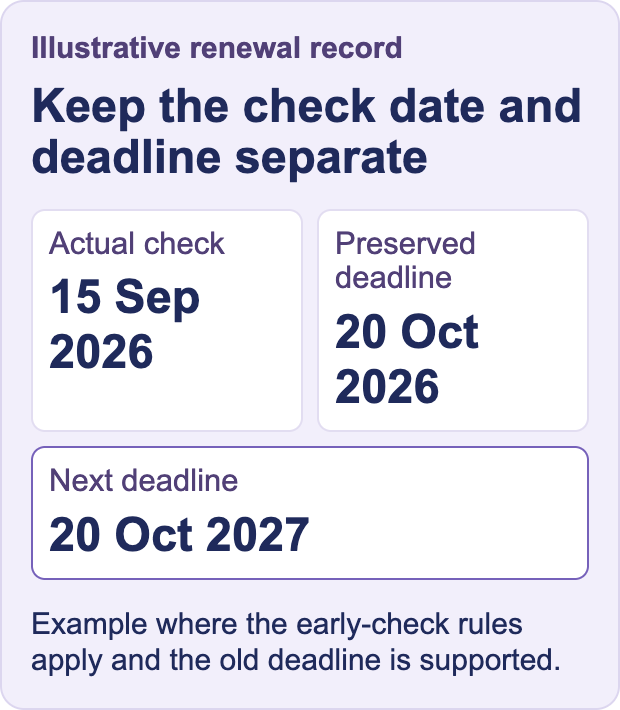
Suppose the existing deadline for a boiler and its flue is 20 October 2026 and the engineer checks both on 15 September 2026. If the landlord can show the audit trail and the early check meets the rule, the next deadline is 20 October 2027, 12 months after the preserved date. The office might choose 1 September 2027 to start arranging access. That call is 49 days before the deadline. The date of the call has no effect on the date of the check.
HSE’s L56 guidance, paragraphs 305 to 310, explains what happens when the landlord can show the latest check but lacks the documents needed to keep a later date. In that case, use 12 months from the actual check. In the example, that would give 15 September 2027 as the next deadline if the September record is reliable and the October date cannot be substantiated. A 1 September call would then give the office 14 days. The same reminder can leave very different time to get the job booked.
Example with a verified existing deadline of 20 October 2026 and a qualifying early check.
- Actual check
- 15 September 2026
- Booking reminder
- 1 September 2027
- Next deadline
- 20 October 2027
The reminder starts the booking process. The records support the deadline.
| What you have | Date to work from | Next move |
|---|---|---|
| Ordinary annual cycle | 12 months from the verified latest check | Record the source and set a booking reminder. |
| Verified early check and preserved deadline | 12 months from the evidenced deadline carried forward | Keep the evidence that links the checks and the deadline. |
| Latest check verified, preservation unsupported | 12 months from the actual latest check | Use the ordinary date and tell the landlord why. |
| No reliable latest check or possible overdue check | Mark the date unverified or overdue, as applicable | Contact the landlord promptly to confirm or arrange the check. |
Read the previous records for the deadline that was in force at the time. If the last visit was itself an early check, simply adding 12 months to that visit can give you the wrong deadline again. Equally, bringing a check forward outside the early window can reset the cycle. HSE’s guide to landlords’ duties explains how that works.
What should the office do if the check might be overdue?
If the booking falls after the deadline the records support, flag it with the landlord promptly and ask whether the visit can be brought forward. Do not assume a general one-week grace period. Raise the case as soon as the date or scope looks doubtful. Give them the address, the appliance or flue in question, the last check you can verify and the document you still need. Ask who is arranging access and whether a Gas Safe registered engineer has already done or booked the check. If the timing or coverage remains uncertain, help the landlord confirm or arrange a check promptly rather than leaving it with the next batch of routine reminders. The HSE guidance on who needs a check explains where the landlord duties apply.
Keep the unverified date visible in the office list, with a named person and a next action. Leave it out of automated messaging while you resolve it. The next person on the phone can then say which report is missing and who is getting it. A later booking can deal with the immediate need for a visit. Keep a record of any gap in the check history so it remains visible after the job is closed.
The landlord retains the duty to demonstrate that the checks were carried out in time. The office can gather the paperwork and organise the visit, and the registered engineer can confirm what was checked and advise on technical questions. If the report shows a defect, ask about the action on that defect as well as the date for next year. HSE explains what landlords should do when a check finds defects.
What should a gas safety reminder app show in a trial?
Give the app two test records before you pay for it or turn on automatic messages. Use a property with a deadline you can evidence and a second record with a signed check and a conflicting spreadsheet date. Use dummy addresses and a test contact you control. The useful result is whether the office can explain both cases from what it sees on screen.
| Trial check | What counts as a pass |
|---|---|
| Actual check and next deadline differ | Both dates stay visible alongside the separately scheduled reminder. |
| Two properties have different statuses | A colleague can find one due check and one completed check, then read the right deadline or actual check date against each property. |
| Someone else opens the property | They can find the signed report and identify the source of the deadline. |
| A disputed date arrives | Staff can review it and keep it out of scheduled messages. |
| One landlord has two flats | The right property, date and recipient stay together in the reminder. |
If staff have to overwrite the actual check date to make the reminder land at the right time, keep the deadline in a controlled register and use a shared calendar for manual follow-ups. Keep the signed reports linked from the register. Give one person ownership of the exception list and have someone else open a sample entry and explain the next date back to them. For a small list with a few disputed dates, that can be a better use of time than buying another app. Once the dates are sound, the guide to tracking renewals across a growing customer book covers the wider diary, and the service reminder setup guide covers routine follow-up.
Checker creates landlord gas safety records from a job and keeps them in the customer history. Checker’s pricing page lists annual service reminders on PRO and PRO+. As of 6 November 2026, the gas engineer software page describes the annual service reminder as running 11 months after customer creation. The service reminders page describes a default of 11 months after the last job. If you want to use Checker for this workflow, check which date drives the reminder on your plan and run the two-record test before relying on it. Keep the separate register if the trial cannot show how your team would handle the disputed date.
Pick one property with two dates on file before you enable the next reminder. If the person answering the phone tomorrow can find the signed record, explain the deadline and say who is dealing with an open question, the diary entry is ready to use.
Authoritative sources
Regulation 36 sets the usual timing and record requirements. Regulation 36A explains when a check in the final two calendar months can keep an existing deadline. HSE’s L56 guidance explains which earlier records and dates show how the deadline was carried forward.
- Gas Safety (Installation and Use) Regulations 1998, regulation 36
- Gas Safety (Installation and Use) Regulations 1998, regulation 36A
- HSE Approved Code of Practice and guidance L56
- HSE guidance on landlord gas safety records
- HSE guidance on maintaining gas appliances and flues
- HSENI gas safety guidance
Try Checker on a gas safety job
On Checker PRO or PRO+, use two test jobs at different properties. Complete one record and leave the other check due. Ask a colleague to find both properties, open the signed record and give you the actual check date for the completed job and the supported deadline for the due one. Check which date drives the reminder before turning it on.
Get Started FreeQuestions about landlord gas safety renewal dates
Does a landlord gas safety record have to show an expiry date?
No. HSE L56 paragraph 309 says an expiry date and the earliest date for an early check are optional on the record. An expiry date is useful for planning when the landlord can show how it was worked out.
Does a new tenancy start a fresh annual check cycle?
No. Give the incoming tenant a copy of the latest current signed gas safety record before they move in. Keep the actual check date on the record. If the earlier records support a later renewal deadline, explain that date separately and keep the evidence behind it.
How long do I keep the records behind a preserved deadline?
Keep the evidence needed to show how the deadline was carried forward, including the two previous gas safety records identified in HSE L56. Regulation 36(3)(c) requires the record for each checked appliance or flue to be kept until two further checks. For an appliance or flue removed from the premises, it specifies two years from its last check.
Does keeping the old deadline change when the check took place?
No. Keep the actual check date on the report and the preserved deadline in a separate field.
For the handover, see how to send a gas safety record and keep proof.

Certificates, quotes and invoices done on site, then service reminders that bring the work back.
Same app everywhere. We show local paperwork, tax and terms, and remember your choice.