
Are Automatic Service Reminders Marketing? What UK Trades Can Send Under PECR and UK GDPR (2026)
A text confirming Tuesday’s visit is a service message. Add an offer or a push to rebook and PECR can treat it as marketing. Here is what the ICO’s published rules let a UK trade send, and to whom.
Updated 19 October 2026
TLDR: A reminder that only confirms a booked visit or states a due date, with nothing promotional in it, is a service message, so PECR’s marketing rules do not apply. Add an offer or a push to rebook and it can become direct marketing, which needs consent, the soft opt-in or a corporate recipient.
To send automatic service reminders by app in the UK, choose one that lets you control the wording and the recipient list. Then a plain reminder stays a service message, and any marketing reaches only people you can lawfully send it to. Our Annual Service Reminder (PRO and PRO+) and Appointment Reminders send by email or text.
You switch on automatic reminders and customers start getting texts and emails under your name. Each is either a service message or marketing, and the UK’s electronic marketing rules (PECR) treat the two differently.
The UK data protection regulator decides which from what the message says, not what you call it. Since 30 September 2026 that regulator is the Information Commission, which took over from the Information Commissioner’s Office and says it will keep the ICO name (ICO announcement). We say ICO below, as its guidance does. The rules below stand as at 19 October 2026.
What counts as a service message and what counts as marketing?
What does PECR mean by direct marketing?
Direct marketing is advertising or marketing material sent to particular people, by any means. The Privacy and Electronic Communications Regulations 2003 (PECR) define it as "the communication (by whatever means) of advertising or marketing material which is directed to particular individuals", and the Data (Use and Access) Act 2025 wrote that into regulation 2 on 20 August 2025. A text to one customer’s number is directed to them. A leaflet through every door is not (ICO guidance on identifying direct marketing).
What is a service message?
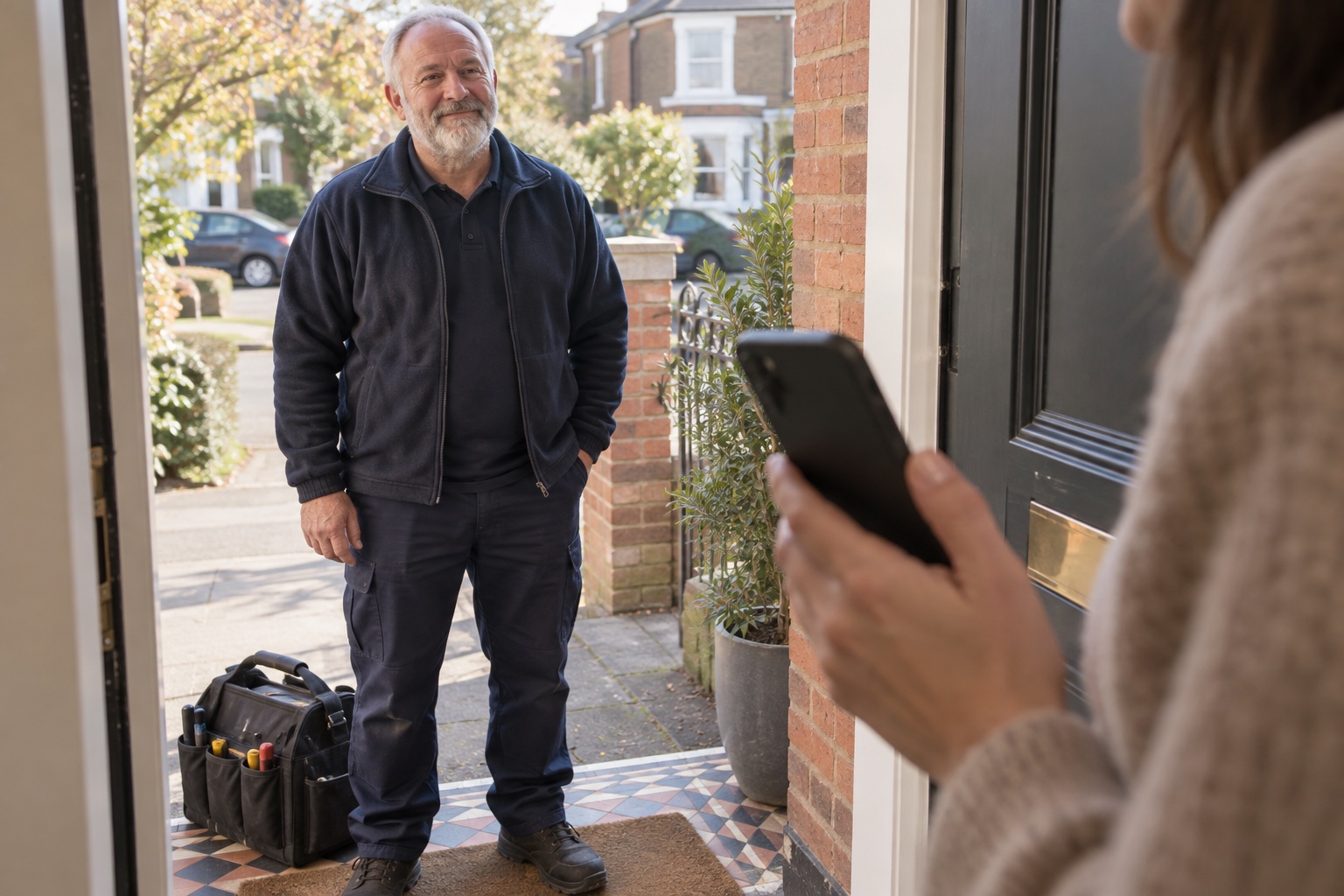
A service message is not promotional and has an administrative or customer service purpose. The ICO’s list includes confirming or reminding people about appointments (ICO guidance, updated 20 August 2025). Its small business guidance gives a heating example: a text saying an engineer will service the central heating at 10am on Tuesday is a service message. Add a line about saving money with a home care plan and it becomes direct marketing.
When does a service message tip into marketing?
When any part of it promotes something, even if administration is the main purpose. A logo or business name alone does not count. The ICO asks why you are using the details, whether you are trying to influence behaviour and whether the content is promotional. A neutral tone helps but does not settle it.
Is an automatic annual service reminder a service message?
It depends on the wording. The ICO pages checked on 19 October 2026 do not rule on boiler or gas safety reminders as a type, so the answer comes from its tests and closest examples.
| Message | Example wording | Where the ICO’s examples point |
|---|---|---|
| Booked visit | Your boiler service is booked for Tuesday at 10am. | Service message. The ICO lists appointment confirmations and reminders. |
| Payment chaser | Invoice 1042 passed its due date on 1 October. | Likely a service message while it only chases payment. The ICO’s example is a call about a failed payment; it names no overdue-invoice example. |
| Neutral due notice | Your annual boiler service is due on 14 November. | Likely a service message. The nearest ICO example is a neutral renewal notice that does not encourage renewal. The ICO pages checked do not rule on this wording. |
| Due notice with a nudge | Your service is due. Book now before diaries fill up. | Points to marketing. The ICO says a message that actively encourages use of a service is likely direct marketing. |
| Reminder with an offer | Your service is due. Book by Friday for 10% off. | Marketing. An offer inside a service message makes it direct marketing. |
Message: Booked visit
Example wording: Your boiler service is booked for Tuesday at 10am.
Where the ICO’s examples point: Service message. The ICO lists appointment confirmations and reminders.
Message: Payment chaser
Example wording: Invoice 1042 passed its due date on 1 October.
Where the ICO’s examples point: Likely a service message while it only chases payment. The ICO’s example is a call about a failed payment; it names no overdue-invoice example.
Message: Neutral due notice
Example wording: Your annual boiler service is due on 14 November.
Where the ICO’s examples point: Likely a service message. The nearest ICO example is a neutral renewal notice that does not encourage renewal. The ICO pages checked do not rule on this wording.
Message: Due notice with a nudge
Example wording: Your service is due. Book now before diaries fill up.
Where the ICO’s examples point: Points to marketing. The ICO says a message that actively encourages use of a service is likely direct marketing.
Message: Reminder with an offer
Example wording: Your service is due. Book by Friday for 10% off.
Where the ICO’s examples point: Marketing. An offer inside a service message makes it direct marketing.
The neutral due notice and the nudge are where trades differ. Our suggestion, not an ICO rule: if you cannot tell which side a due notice falls on, treat it as marketing and check that each recipient could lawfully receive it.
What happens when a firm calls marketing texts service updates?
On 20 January 2026 the ICO fined Allay Claims Ltd £120,000 for more than 4 million marketing texts sent between February 2023 and February 2024 (ICO announcement of the fines). The firm later called them service updates. The ICO found them promotional and found no simple way to refuse marketing when details were collected, so the soft opt-in was unavailable. It was a claims firm, but the test is the same for a trade.
If a reminder is marketing, who can you send it to?
Regulation 22 covers unsolicited marketing by electronic mail, which includes texts (regulation 2). For individuals the default is consent. The 5 February 2026 amendment added a soft opt-in for charities and left the rule for trades unchanged.
Who is an individual subscriber?
Individual subscribers are people, sole traders and ordinary partnerships. Corporate subscribers are limited companies, limited liability partnerships, Scottish partnerships and some public bodies (ICO business-to-business marketing guidance). A landlord who owns property personally is likely to be an individual or a sole trader. A limited company landlord or letting agent is corporate. An email address does not show which.
Marketing to a corporate subscriber needs neither consent nor the soft opt-in. You must still say who you are and give a valid opt-out address (regulation 23), and UK data protection law applies where the address names a person.
When can the soft opt-in cover an existing customer?
When all five conditions that the ICO draws from regulation 22(3) hold (ICO electronic mail marketing guidance):
- You got the contact details yourself, from the customer. A bought list never qualifies.
- You got them while selling, or negotiating to sell. A quote request counts. Browsing a website does not.
- The marketing covers only your own similar products and services.
- You offered a simple opt-out when you collected the details. A box hidden in a privacy policy fails, and one added to a later confirmation comes too late.
- Every later message offers the opt-out again.
The ICO’s small business example is a car: a customer who bought one can be marketed servicing or MOTs. For texts, the ICO suggests a stop message to a code number, free apart from the cost of the reply.
What if the customer asked for the reminder?
Then the message is solicited, and the ICO says solicited marketing needs no consent and no soft opt-in (ICO key concepts). A customer who says at the job, “text me when it is due next year”, has asked. Note who, when and how.
If you take consent instead, it must be freely given, specific, informed and unambiguous. Pre-ticked boxes do not count, and the ICO says to ask for email and text consent separately. Verbal consent works if you record it.
What does UK GDPR add, whatever the message type?
Do you need a lawful basis for a service message?
Yes. A mobile number is personal data, so every message needs a lawful basis, marketing or not. The ICO lists six. For marketing, the likeliest are consent and legitimate interests (ICO lawful basis table).
Can a customer make you stop?
For marketing, yes. The right to object is absolute, with no grounds to refuse (ICO right to object). Suppress rather than delete: keep just enough to remember the preference, in a do-not-contact list.
What changed in 2026?
- 5 February 2026: the ICO can fine up to £17.5 million or 4% of global turnover under PECR (ICO statement).
- 30 September 2026: the Information Commission took over the ICO’s functions, with the same role and powers (GOV.UK). It says it will keep the ICO name, and its guidance still carries it (ICO announcement).
- Now: several ICO pages say they are under review after the Data (Use and Access) Act. Recheck before relying on a detail.
How do you set up automatic reminders so they stay on the right side of the rules?
- List every automatic message. Mark each as a booked visit, a payment chaser, a due notice or an offer.
- Keep booking and payment messages plain. State who, what, when and how to reach you. A logo or business name is fine.
- Test each due notice. Ask why you are sending it and whether it is promotional. A call to rebook, a discount or a plug for other work makes it marketing.
- Confirm a route for each marketing recipient. The customer asked for it, the soft opt-in conditions hold, or the recipient is a corporate subscriber.
- Put a free opt-out in every marketing message. Reply STOP works for texts. Add every opt-out to a do-not-contact list as soon as you receive it.
- Keep the records. Note when and how you collected each customer’s details and what they asked for.

What does this look like for a 200-customer book?
Take 200 customers on an annual cycle. These assumptions are illustrative, not Checker data.
- 130 homeowners and 30 sole-trader or ordinary-partnership landlords: 160 individuals.
- 30 limited companies and letting agents: corporate.
- 10 customers with no recorded status, treated as individuals.
- 100 of the 160 individuals got a clear opt-out when you took their details, and the other soft opt-in conditions hold.
Booked-visit and payment messages go to all 200. The nudge version is marketing.
| Group | Customers | Route under regulation 22 | Can receive it today |
|---|---|---|---|
| Limited companies and letting agents | 30 | None needed. Identify yourself and give a valid opt-out address. | 30 |
| Individuals given a clear opt-out at collection | 100 | Soft opt-in, if the other conditions hold | 100 |
| Individuals never given that opt-out | 60 | Consent first | 0 |
| Status not recorded, treated as individuals | 10 | Consent first | 0 |
| Total | 200 | 130 (65%) |
Group: Limited companies and letting agents
Customers: 30
Route under regulation 22: None needed. Identify yourself and give a valid opt-out address.
Can receive it today: 30
Group: Individuals given a clear opt-out at collection
Customers: 100
Route under regulation 22: Soft opt-in, if the other conditions hold
Can receive it today: 100
Group: Individuals never given that opt-out
Customers: 60
Route under regulation 22: Consent first
Can receive it today: 0
Group: Status not recorded, treated as individuals
Customers: 10
Route under regulation 22: Consent first
Can receive it today: 0
Group: Total
Customers: 200
Can receive it today: 130 (65%)
Thirty corporate plus 100 soft opt-in gives 130 of 200, or 65%. The other 70 need consent first.
Where does Checker fit into this?
What can Checker’s reminders do?
Our Automations run four workflows, including Appointment Reminders (24 hours before the visit by default, adjustable from 1 to 48 hours) and the Annual Service Reminder (1 to 12 weeks before a file expires, four by default, set per file type).
You edit the wording and choose the channel. Replies reach your own inbox, or your mobile for a text, and a copy of every message sits in the Email tab. The service reminders page adds a printed letter and a setting that marks a customer or job as no reminders.
Our default Annual Service Reminder wording explains why the service matters and asks whether the customer wants to rebook. A practical suggestion, not an ICO ruling: check the route for each customer, or edit the wording to a plain due notice.
Which plan includes the reminders?
The Annual Service Reminder and the customer database sit on PRO at £19.99 a month and PRO+ at £25.99, plus VAT. LITE at £10.99 lists no CRM, reminders or accounts sync on the pricing page. Text reminders use text credits priced at cost (service reminders page). Keep offers out of the reminder: the pricing page lists email marketing as a separate PRO and PRO+ feature.
What stays with you?
A reminder prompts a booking. It does not carry out the service or make anyone compliant. Whether a message is a service message, who agreed to receive it and how you honour a STOP reply stay with you.
| Option | What you control | What stays with you |
|---|---|---|
| Your own phone, by call or text | Every word and every recipient | Texts follow the same rules as other electronic mail. Live marketing calls fall under separate telephone preference rules. |
| Bulk text or email service | Wording, list and timing | The ICO says a bulk email platform does not normally become responsible. You remain responsible. |
| Printed letter | Wording and who gets one | PECR’s electronic mail rules do not cover post. A named address still needs a lawful basis. |
| Checker automations | Wording, channel, lead time and a no-reminders setting; replies reach you | Deciding whether each message is a service message, and the record of who agreed to what. |
Option: Your own phone, by call or text
What you control: Every word and every recipient
What stays with you: Texts follow the same rules as other electronic mail. Live marketing calls fall under separate telephone preference rules.
Option: Bulk text or email service
What you control: Wording, list and timing
What stays with you: The ICO says a bulk email platform does not normally become responsible. You remain responsible.
Option: Printed letter
What you control: Wording and who gets one
What stays with you: PECR’s electronic mail rules do not cover post. A named address still needs a lawful basis.
Option: Checker automations
What you control: Wording, channel, lead time and a no-reminders setting; replies reach you
What stays with you: Deciding whether each message is a service message, and the record of who agreed to what.
Checker is not the answer if you only confirm visits by phone from your own diary.
See the reminder settings and wording on your own customer list before you send the first batch. Get Started Free
Frequently asked questions
Is a text confirming tomorrow’s appointment marketing?
No. The ICO lists confirming or reminding people about appointments as service messages, provided the text contains nothing promotional. Add an offer or a push to buy and it becomes direct marketing.
Do I need consent to send a reminder that an annual service is due?
It depends on the wording and the recipient. A neutral due notice sits near the ICO’s example of a neutral renewal notice. A notice that pushes the customer to rebook, or carries an offer, is more likely marketing. For marketing, a corporate subscriber needs no consent, an individual needs consent or the soft opt-in, and a customer who asked for the reminder needs neither.
Can I text a landlord who is a sole trader?
Treat a sole trader like any individual. PECR classes sole traders and ordinary partnerships as individual subscribers, so marketing texts need consent or the soft opt-in. An email address does not show whether someone is a sole trader or a limited company.
What must an opt-out look like on a text?
Simple and free apart from the cost of the reply. The ICO suggests telling people to send a stop message to a code number. Do not make anyone log in or create an account to unsubscribe.
Check your reminders before the next batch goes out
Check each automatic message against this list:
- Does it say anything beyond the visit, the date or the payment?
- For each marketing-style message, can you name the route for every recipient?
- Does every marketing message offer a free opt-out, with every opt-out on your list?
Further reading
Authoritative sources
- Checker Automations: quote, invoice and service chasers
- Checker service reminders
- Checker current pricing
- How to Set Up Automated Service Reminders for UK Gas, Heating and Electrical Work (2026)
- How to Set Up Automated Gas Boiler Service and Safety Check Reminders (UK, 2026)
- How to Track Gas Safety Certificate Renewals Across a Growing Customer Book (2026)
- Privacy and Electronic Communications (EC Directive) Regulations 2003, regulation 22 (as amended)
- Privacy and Electronic Communications (EC Directive) Regulations 2003, regulation 23
- Privacy and Electronic Communications (EC Directive) Regulations 2003, regulation 2 (interpretation)
- ICO: identify direct marketing
- ICO: marketing and data protection in detail (small organisations)
- ICO: how do we comply with the PECR electronic mail marketing rules?
- ICO: key concepts for direct marketing using electronic mail
- ICO: business-to-business marketing
- ICO: sending direct marketing, choosing your lawful basis
- ICO: right to object
- ICO: fines of £225,000 for nuisance marketing messages, 20 January 2026
- ICO: statement on the commencement of the Data (Use and Access) Act, 5 February 2026
- ICO: ICO governance changes confirmed for 30 September 2026, 15 September 2026
- GOV.UK: Information Commission succeeds the ICO as the UK’s data protection regulator, 30 September 2026