
BS 7671 Amendment 4 Is Now the Only Current Edition: What Changes on the EIC, EICR and Minor Works Forms You Issue (UK, 2026)
BS 7671 Amendment 4 has been the only current edition since 15 October 2026. What changed on the EIC, EICR and minor works forms, and what A2 reports mean now.
Updated 23 November 2026
TLDR: Since 15 October 2026, BS 7671:2018+A4:2026 is the only current edition. New EICs, EICRs and minor works certificates should use the Amendment 4 model forms. An EICR correctly issued before then stays valid for its stated interval. The biggest form change is that an FI code no longer makes an EICR unsatisfactory.
A letting agent sends back an EICR you issued in November because the header still reads BS 7671:2018+A2:2022. The testing was sound, and the only fault is that the paperwork names an edition that stopped being current on 15 October.
The fix is mostly paperwork. Amendment 4 changed what the model forms ask you to record, and most electricians fill those forms in an app. If the app still prints the old layout, every certificate it produces carries the old edition and misses the new fields.
Fill in the Electrical Installation Certificate, EICR or minor works certificate on site, get it signed on the device and keep the PDF with the customer record.
Jump to:
- Which edition of BS 7671 is current?
- What changed on the EIC, EICR and minor works forms?
- Is an EICR issued under Amendment 2 still valid?
- When does Amendment 4 not change anything?
- What should you check in your certificate software?
- Where does Checker fit?
- A five-point check before the next certificate leaves site
- Frequently asked questions
Which edition of BS 7671 is current?
BS 7671:2018+A4:2026 (Amendment 4) is the current edition. The IET's BS 7671 page says the transition period for Amendment 2 ended on 15 October 2026 and that electrical professionals should use Amendment 4, “which is now the current edition of the national standard for electrical installations in the UK.”
The outgoing edition had a longer name. Amendment 3 was published in 2024 and sat on top of Amendment 2, so BSI and Electrical Safety First describe the withdrawn version as BS 7671:2018+A2:2022+A3:2024. Amendment 3 brought no model forms of its own: the IET model forms page lists three sets, the 2018 originals, the Amendment 2 set and the Amendment 4 set. If your forms predate Amendment 4, they are the Amendment 2 layout.
Amendment 4 was issued on 15 April 2026 and could be used straight away, according to the ECA and Electrical Safety First's Best Practice Guide 4. BSI calls the six months that followed a transition period, and that period is now over. Any certificate or report dated after 15 October 2026 should certify or report against Amendment 4.
What changed on the EIC, EICR and minor works forms?
The largest change is what an FI code means on the EICR, and the forms also ask for more supply and protective device detail in a new layout. Each declaration still asks you to write the date the standard was “amended to”, so that line on every new certificate should point to Amendment 4.
Set side by side, the IET's Amendment 4 PDFs (EIC, EICR, minor works) and Amendment 2 PDFs (EIC, EICR, minor works) differ in these ways that change what you fill in:
| Form | What changed under Amendment 4 | What to check |
|---|---|---|
| All three | Header reads BS 7671:2018+A4:2026, with a 15 April 2026 issue date | Edition in the header and the “amended to” date |
| EIC | Sections are now lettered A to J, as the EICR already was | Section letters match the model form |
| EIC and EICR | TN-C-S is split into TN-C-S (PME) and TN-C-S (PNB) | Both TN-C-S options appear as separate choices |
| EIC and EICR | Main switch adds a breaking capacity field, and RCD type becomes a choice of AC, A, F, B or other | Breaking capacity field and the four RCD type options |
| EIC and EICR | Supply protective device now asks for breaking capacity | A breaking capacity field beside the supply fuse |
| EIC | Departure boxes add Regulation 133.1.3, and some add 133.1.2 | Departure boxes quote the new regulation numbers |
| EIC and EICR schedules | Insulation resistance on an EIC is tested at the Table 64 voltage | The test results schedule carries the Table 64 note |
| EICR | FI reads “further investigation is advised” and is advisory | FI no longer forces an unsatisfactory outcome |
| EICR | C1 and C2 observations are listed apart from C3 and FI | Two observation lists, outcome linked to C1 and C2 |
| EICR | New standard limitation: no checks for safety alerts or product recalls | The limitation line prints in Section D |
| MEIWC | Parts 1 to 5 become Sections A to E | Section letters match the model form |
| MEIWC | Earthing adds TN-C-S (PME), TN-C-S (PNB), TN-C and IT | Six earthing options, up from three |
| MEIWC | Circuit details add breaking capacity and RCD rated time delay | Both fields appear in the circuit details |
Form: All three
What changed under Amendment 4: Header reads BS 7671:2018+A4:2026, with a 15 April 2026 issue date
What to check: Edition in the header and the “amended to” date
Form: EIC
What changed under Amendment 4: Sections are now lettered A to J, as the EICR already was
What to check: Section letters match the model form
Form: EIC and EICR
What changed under Amendment 4: TN-C-S is split into TN-C-S (PME) and TN-C-S (PNB)
What to check: Both TN-C-S options appear as separate choices
Form: EIC and EICR
What changed under Amendment 4: Main switch adds a breaking capacity field, and RCD type becomes a choice of AC, A, F, B or other
What to check: Breaking capacity field and the four RCD type options
Form: EIC and EICR
What changed under Amendment 4: Supply protective device now asks for breaking capacity
What to check: A breaking capacity field beside the supply fuse
Form: EIC
What changed under Amendment 4: Departure boxes add Regulation 133.1.3, and some add 133.1.2
What to check: Departure boxes quote the new regulation numbers
Form: EIC and EICR schedules
What changed under Amendment 4: Insulation resistance on an EIC is tested at the Table 64 voltage
What to check: The test results schedule carries the Table 64 note
Form: EICR
What changed under Amendment 4: FI reads “further investigation is advised” and is advisory
What to check: FI no longer forces an unsatisfactory outcome
Form: EICR
What changed under Amendment 4: C1 and C2 observations are listed apart from C3 and FI
What to check: Two observation lists, outcome linked to C1 and C2
Form: EICR
What changed under Amendment 4: New standard limitation: no checks for safety alerts or product recalls
What to check: The limitation line prints in Section D
Form: MEIWC
What changed under Amendment 4: Parts 1 to 5 become Sections A to E
What to check: Section letters match the model form
Form: MEIWC
What changed under Amendment 4: Earthing adds TN-C-S (PME), TN-C-S (PNB), TN-C and IT
What to check: Six earthing options, up from three
Form: MEIWC
What changed under Amendment 4: Circuit details add breaking capacity and RCD rated time delay
What to check: Both fields appear in the circuit details
The minor works certificate's notes now name consumer units alongside distribution boards as work it does not cover, and its guidance for recipients explains whose signature appears on it. Amendment 4 also added a separate model form, the Schedule of Supplementary Protective Equipotential Bonding Inspection and Test Results, which has no Amendment 2 version on the IET page.
Why does the FI change matter most?
It changes the outcome of a report. On the Amendment 2 EICR, the notes told the inspector to record an FI observation “given the code FI and marked as unsatisfactory in Section E”, and the code read “Further investigation required without delay.” On the Amendment 4 EICR, Section E says any observation coded C3 or FI “is advisory and does not affect the overall assessment but should be given due consideration.”
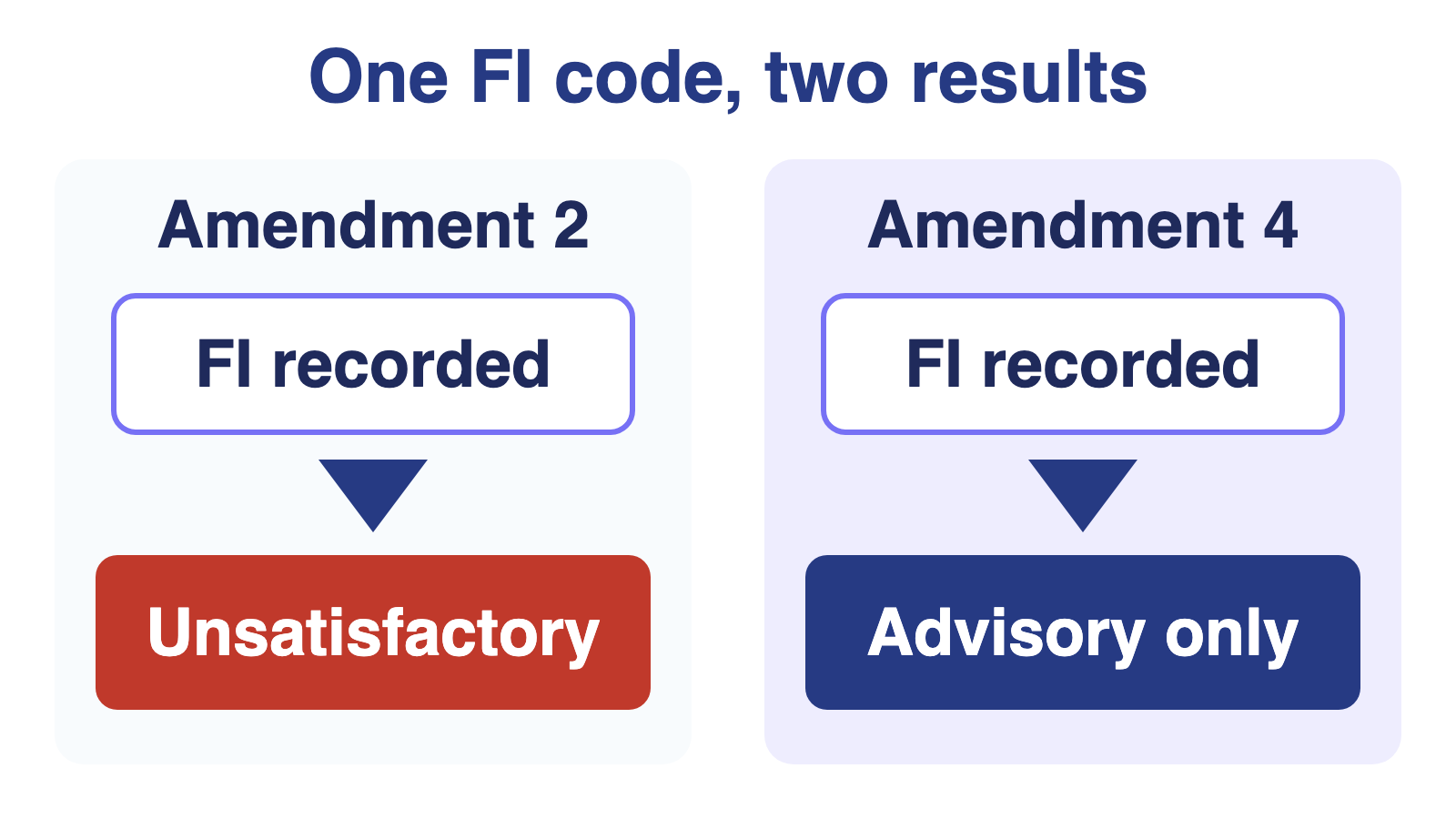
Michael Peace explains the reason in the IET's Wiring Matters, July 2026: C3 and FI have been decoupled from C1 and C2 so the person responsible can see which observations make the report unsatisfactory and need remedial work. He also says FI should not be needed in most cases, and gives two examples of misuse: an unidentified circuit, and an insulation resistance reading below 1 MΩ. He treats both as non-compliances to code, with finding the cause left to remedial work or fault-finding.
Is an EICR issued under Amendment 2 still valid?
Yes. An EICR correctly issued before 15 October 2026 stays valid for the interval it states. The Amendment 4 model EICR says a report records observations “limited to the requirements of BS 7671, current at the time of the inspection”, and its guidance for recipients describes the condition “at the date of inspection and testing”. A report done in September against Amendment 2 was done against the edition current that month.
The landlord rules work on intervals too. In England, regulation 3 requires inspection and testing at intervals of no more than five years, or sooner if the last report says so. GOV.UK's guidance answers the new-tenancy question directly: if the inspection was less than five years ago and the report needs no further investigative or remedial work, no new inspection is needed. Neither ties validity to the edition named on the form. Wales, Scotland and Northern Ireland also work on five-year cycles, with Wales and Northern Ireland setting them in regulations and Scotland in its Repairing Standard guidance.
So the answer for the letting agent depends on the report's date. Before 15 October, the Amendment 2 header is correct and the report runs to its next inspection date. A report dated after 15 October names an edition the IET now says should no longer be referenced for certification. The inspector should reissue it on the Amendment 4 form, checking each observation and code against Amendment 4 before signing it again.
When does Amendment 4 not change anything?
An amendment does not make compliant past work non-compliant. The Amendment 4 EICR notes say an installation designed to an earlier version of BS 7671 “is not necessarily unsafe for continued use, or require upgrading”. Do not re-test a rental early, or downgrade a satisfactory report, because the edition changed.
FI on a rental still needs care, because the landlord guidance has not caught up with the form. GOV.UK's guidance for England still describes FI as “Further investigation required without delay” and says that if an inspector identifies that further investigative work is required, the landlord must ensure it is carried out. Where the report requires further investigative or remedial work, the England regulations give 28 days starting with the date of the inspection, and Northern Ireland's regulations set the same 28 days.
As a practical example, take an EICR on a rented flat in England, inspected on 3 November 2026 on an Amendment 4 form, with one FI observation and two C3s. The form makes the overall assessment satisfactory. If the report says further investigation is required, the 28 days counted from 3 November (inspection day counts as day one) end on 30 November 2026. Write the FI observation plainly, say what investigation you advise and by when, and put the 28-day date in your covering note. The landlord then has your advice in writing, whichever way the form and the guidance are read.
What should you check in your certificate software?
Check the edition and the new fields on a real form before your next job, whatever app you use. Your customer only ever sees what the template prints, so the template is what needs checking. Open a blank EIC, EICR and minor works certificate and run these checks:
- Edition. The header names BS 7671:2018+A4:2026, and the “amended to” date on each declaration points to Amendment 4.
- Earthing and supply. TN-C-S (PME) and TN-C-S (PNB) appear as separate options, and the supply and main switch details include breaking capacity, with RCD type as AC, A, F or B.
- EICR coding. C1 and C2 observations sit apart from C3 and FI, and FI reads “further investigation is advised” without forcing an unsatisfactory result.
- Limitations. Section D carries the line about safety alerts, corrective actions and product recalls.
- Minor works. The form uses Sections A to E, offers six earthing options and asks for breaking capacity and RCD rated time delay.
If any check fails, ask your supplier when its Amendment 4 forms arrive, and hold certificates that cite the wrong edition until they do. For which document a job needs in the first place, see our guide to creating and sending electrical reports and certificates.
Where does Checker fit?
Checker produces the Electrical Installation Certificate, the Electrical Installation Condition Report for supplies up to 100A, and the Minor Electrical Installation Works Certificate, with quotes and invoices on the same job. As our electrical software page sets out, the forms follow BS 7671 layouts: you fill them in on site, collect the customer's signature on the device and keep the finished PDF with the customer history. If you lose signal, the app saves your work on the device and syncs when you are back in range.
On PRO, you can add reminders for EICR renewals, so the next inspection date on a rental becomes a prompt to book the job. The reminder brings the job back round, and booking and doing the inspection stays with you. Our plans are LITE at £10.99, PRO at £19.99 and PRO+ at £25.99 a month, plus VAT, with Xero two-way sync of invoices and payments on PRO and PRO+.
Checker is the wrong fit for an EICR on a supply above 100A, because our EICR covers supplies up to 100A; larger commercial and industrial installations need a form built for them. If an EICR turns up C2s, our guide to quoting and invoicing EICR C2 remedial work covers the next step. For choosing an app, see our EICR software comparison and our guide to NICEIC and NAPIT certification software.
A five-point check before the next certificate leaves site
- The header and the “amended to” date name Amendment 4.
- The earthing arrangement uses the TN-C-S (PME) or TN-C-S (PNB) choice where TN-C-S applies.
- Breaking capacity is filled in for the supply and main switch, and the RCD type is picked from AC, A, F or B.
- On an EICR, every FI is written plainly with the investigation you advise.
- On a rental, the landlord knows which observations need action within 28 days.
Try the EIC, EICR and minor works forms on your next job, with the PDF saved against the customer and the address.
Frequently asked questions
Did Amendment 3 have its own model forms?
No. The IET model forms page lists forms for BS 7671:2018, Amendment 2 and Amendment 4 only. Amendment 3:2024 was added to Amendment 2, so the withdrawn edition is described as BS 7671:2018+A2:2022+A3:2024, and its forms were the Amendment 2 set.
Can I still use Amendment 2 forms I printed or saved?
Not for work dated after 15 October 2026. The IET says professionals should use Amendment 4, now the current edition, and the Amendment 4 forms ask for details the Amendment 2 forms do not, such as breaking capacity and the PME or PNB earthing choice.
Is there a new model form under Amendment 4?
Yes. The IET lists a Schedule of Supplementary Protective Equipotential Bonding Inspection and Test Results among the Amendment 4 downloads, with no Amendment 2 equivalent on the same page.
Does an FI code still make an EICR unsatisfactory?
Not on the Amendment 4 form. Section E says C3 and FI observations are advisory and do not affect the overall assessment. In England, GOV.UK guidance still says landlords must have required further investigation carried out, so write FI observations clearly on rental reports.
Where can I download the Amendment 4 model forms?
From the IET model forms page, free of charge, under its terms of use. The IET permits copying or electronic changes for use in your own electrical contracting business, and the IET logo must not be reproduced on copies.
Authoritative sources
- IET: BS 7671 18th Edition, current edition and end of the Amendment 2 transition
- IET: model forms for BS 7671:2018+A4:2026, +A2:2022 and 2018
- IET: Electrical Installation Certificate, BS 7671:2018+A4:2026 model form
- IET: Electrical Installation Condition Report, BS 7671:2018+A4:2026 model form
- IET: Minor Electrical Installation Works Certificate, BS 7671:2018+A4:2026 model form
- IET: Electrical Installation Certificate, BS 7671:2018+A2:2022 model form
- IET: Electrical Installation Condition Report, BS 7671:2018+A2:2022 model form
- IET: Minor Electrical Installation Works Certificate, BS 7671:2018+A2:2022 model form
- IET Wiring Matters, July 2026: Further investigation, by Michael Peace
- IET: Amendment 4:2026 to BS 7671:2018 publications
- BSI: BS 7671:2018+A4:2026, the latest amendment to the UK's Wiring Regulations
- ECA: Amendment 4 of the 18th Edition Wiring Regulations
- ECA news, 15 April 2026: new electrical standard amendment
- Electrical Safety First: Best Practice Guide 4, Issue 7.4, August 2026
- GOV.UK: electrical safety standards in the private and social rented sectors, guidance
- Electrical Safety Standards in the Private Rented Sector and Social Rented Sector (England) Regulations 2020, regulation 3
- Renting Homes (Fitness for Human Habitation) (Wales) Regulations 2022, regulation 6
- Electrical Safety Standards (Private Tenancies) Regulations (Northern Ireland) 2024, regulation 3
- Scottish Government: Repairing Standard statutory guidance, electrical safety
- Checker: job management and certification software for UK electricians
- Checker: electrician app for the UK
- Checker pricing