Leaving Joblogic as a Small Electrical Contractor: How to Keep Your EICR History, Open Remedials and Retest Dates (UK, 2026)
Before an electrical firm cancels Joblogic, three records need their own export: issued certificates as PDFs by address, open C1, C2 and FI remedial quotes, and every retest date. Here is the cutover in seven steps.

Updated 14 November 2026
TLDR: Before you cancel Joblogic, export and check three things: every issued electrical certificate as a readable PDF filed under its address, every open remedial quote with its code and date, and every retest or service due date. The customer and job lists matter least. This is for 2 to 10 person electrical firms.
The cancellation email is drafted. Then someone in the office asks where last year's EICRs for the letting agent's twelve flats will live once the Joblogic login stops working, and nobody has a quick answer.
For a small electrical contractor, that is where the switching risk sits: the certificate trail and the due dates. The customer list is the easy part. Copy the customers but lose the certificates, the quoted C2 work and the five-year retest dates, and you lose the work that pays for the next five years. If you are still choosing where to go, our Joblogic alternatives guide compares the options; this guide is about getting out cleanly.
Checker issues EICRs, EICs and minor works certificates from the job, files each PDF against the property and, on PRO, reminds you when the next one is due.
Get Started FreeJump to:
- What does a small electrical firm actually hold in Joblogic?
- Why do certificates have to leave as documents, not data rows?
- Why are open remedials and retest dates the revenue?
- What is the cutover sequence, step by step?
- What does this look like for one letting agent's twelve flats?
- What should you check in the new system, and where does Checker fit?
- Who should stay on Joblogic?
- Frequently asked questions
What does a small electrical firm actually hold in Joblogic?
Most of the value in the account sits outside the job list. A small firm on Joblogic usually holds customers and sites, assets, completed forms, planned visits, quotes and invoices.
Joblogic's free Electrical Industry Pack sets up 22 forms, including the EICR, EIC, Minor Electrical Installation Works Certificate, emergency lighting and PAT forms, along with ready-made asset types, job types and PPM schedules. Its electrician software page says remedial work quotes can be logged against existing jobs and that repeat site visits can be cloned on a set schedule. Its planned maintenance page generates visit dates from the frequency you pick for each site.
Three of those records carry future money:
- Issued certificates and reports: the evidence of work done, filed against a site.
- Open remedial quotes: C1, C2 and FI work you have priced but not yet done.
- Due dates: the next inspection date on each EICR, plus every planned or recurring visit.
Customers, sites and invoice history matter too, but they are easy to rebuild and your accounts package already holds the invoices. The three above are not easy to rebuild, which is why they decide the order of the move.
Why do certificates have to leave as documents, not data rows?
Certificates are evidence, so they must leave as finished PDFs tied to an address. A spreadsheet row with a date and a tick against Flat 4 proves nothing to a landlord, a council or a scheme assessor.
Landlords in England must keep a copy of each EICR until the later of the next inspection's due date and the date it is carried out, unless a newer report supersedes it, and must give that copy to the person doing the next inspection (Electrical Safety Standards Regulations 2020, regulation 3). That next person is often you. Your scheme cares too. NICEIC's Domestic Installer scheme asks members to keep records, including certificates, for at least 6 years. Under NAPIT's installer scheme rules (version 2.0, April 2026), a member who notifies a job warrants that it complies with the Building Regulations and will put right evidenced non-compliance for 6 years. A contract claim can also be brought up to six years after the cause of action (Limitation Act 1980, section 5).
Joblogic's Marketplace lists two routes to the documents. The Bulk Form Downloader pulls every completed form matching a filter (customer, site, job, asset or engineer) in one action. The Bulk Attachment Downloader packages files attached to customers, sites or jobs, such as PDFs and certificates, typically in a structured zip folder. Both are Marketplace tools with the price on request, so ask for them early.
Export early, while the account is fully paid. Joblogic's Terms of Use say you own your data, but your access to it depends on paying the access fee, you must keep your own copies, and on termination you stop using the service.
Why are open remedials and retest dates the revenue?
Open remedials and due dates are next month's and next year's work, so they need their own export and a check against the certificates. They do not come across by accident with a customer list.
Remedials carry a clock. On an EICR, C1 means danger present and C2 means potentially dangerous; either makes the report unsatisfactory and remedial work is required. FI means further investigation is required without delay (GOV.UK guidance for private and social landlords, published 1 November 2025). The landlord then has 28 days, or less if the report says so, to get the work done. A quote that disappears at cutover can cost the landlord that deadline and cost you the job.
Due dates carry the repeat work. An EICR for a rented home must give the date by which the next inspection is required, at intervals of no more than 5 years in England (regulation 3). Planned visits sit in schedules, not in the certificates themselves. Joblogic's reports can be exported as PDF and spreadsheet files (reporting and dashboards), and its Reporting Database, price on request, gives access to records for jobs, quotes, invoices, PPM contracts and assets. Whichever route you use, you want two lists you can hold up against the PDFs:
- Open remedials: site, observation code, item, price, date sent, inspection date and deadline.
- Due dates: site, document or visit type, last done and next due.
Keep the customer's email address and mobile number with each due date, so the reminder can reach the person who books the work.
What is the cutover sequence, step by step?
Run the move in this order, so each step uses what the last one produced.
- Find your notice date. Read your own Joblogic agreement for the date your payment period ends. Most customers commit to 24 or 36 months (Joblogic pricing), and the Terms of Use ask for notice at least 30 days before the end of the relevant payment period, sent to support@joblogic.com.
- Set the cutover date. Choose a date at least two weeks before access ends. From that date, no new certificates are issued in Joblogic.
- Export every certificate as a PDF, by site. Use the Bulk Form Downloader or the Bulk Attachment Downloader, and save the files in folders by customer and address.
- Export open remedials. List every unfinished C1, C2 and FI item with its code, price, quote date and 28-day deadline.
- Export due dates. Take the next inspection date from each EICR and every recurring or planned visit from Joblogic's schedules.
- Test retrieval. Someone who did not run the export picks five addresses and finds the latest certificate, any open remedial and the next due date for each.
- Load, then cancel. Load the due dates into the new system as reminders, finish or re-issue open quotes, and only then send the notice.
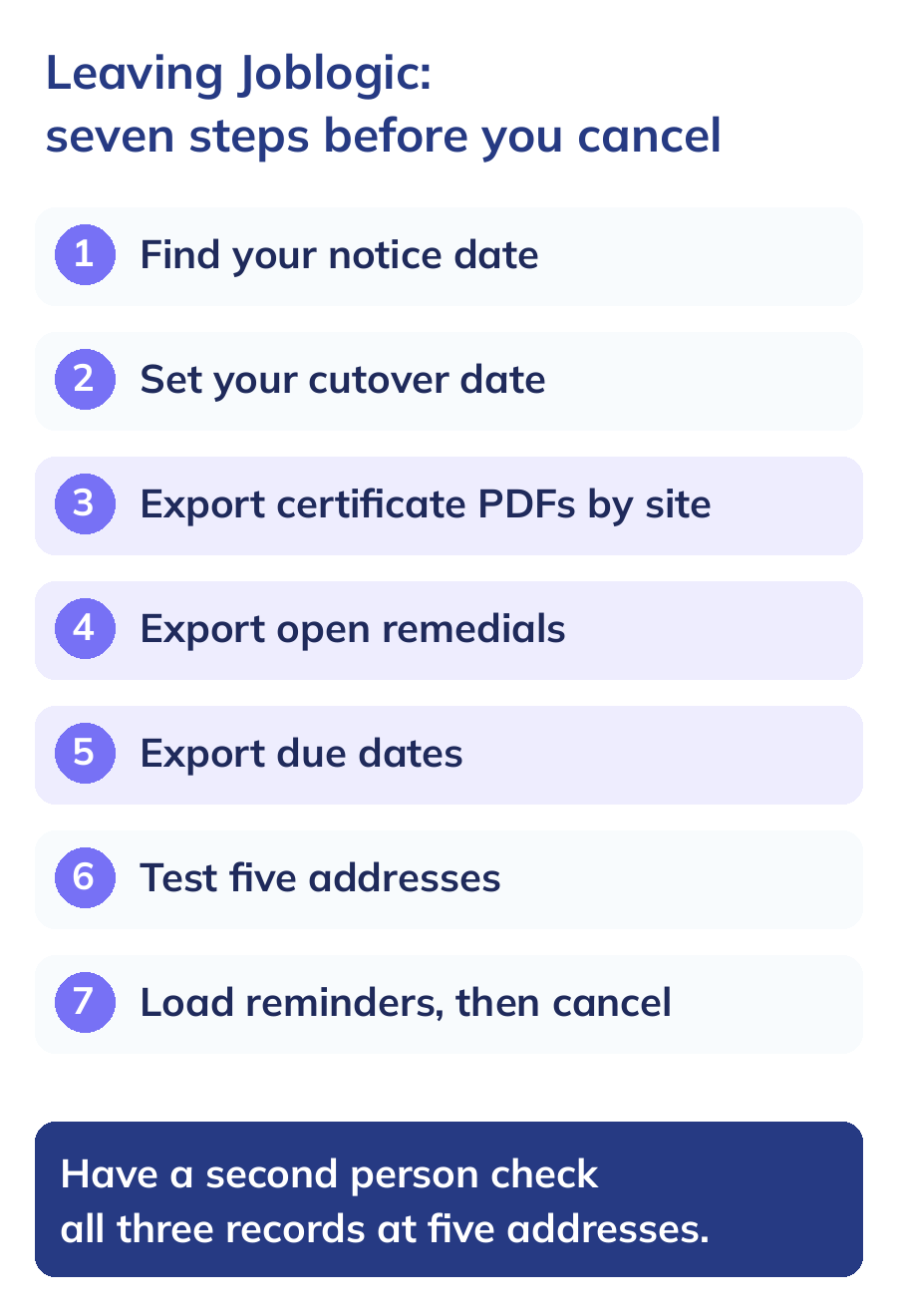
Step 6 is the one people skip. Our guide to testing a closed-job archive when leaving Tradify explains why the person who ran the export is the wrong person to check it.
What does this look like for one letting agent's twelve flats?
Here is a practical example. These figures are our assumptions, dated 13 November 2026, not Joblogic or market data:
- a four person firm (owner, office manager, two electricians) on Joblogic Standard, which Joblogic lists from £49 per user a month, billed annually (Joblogic pricing, checked 13 November 2026), so at least £196 a month;
- a payment period under the firm's agreement that ends on 31 December 2026, which makes 1 December 2026 the last day to give 30 days' notice;
- one letting agent with twelve flats, all inspected on 3 November 2026.
Nine flats passed. Three did not, and that is where the risk sits. The 28 days begin on the inspection day, so the landlord's deadline is 30 November 2026, a day before the planned 1 December cutover.
| Flat | Finding and quote | Open value |
|---|---|---|
| Flat 3 | Two C2 items, quote accepted, work booked | £275 plus £55 VAT |
| Flat 7 | One C2 item, quote sent, no reply | £240 plus £48 VAT |
| Flat 9 | FI, fixed-price investigation quoted | £120 plus £24 VAT |
| Total | Three open remedials | £635 plus £127 VAT, £762 |
Flat: Flat 3
Finding and quote: Two C2 items, quote accepted, work booked
Open value: £275 plus £55 VAT
Flat: Flat 7
Finding and quote: One C2 item, quote sent, no reply
Open value: £240 plus £48 VAT
Flat: Flat 9
Finding and quote: FI, fixed-price investigation quoted
Open value: £120 plus £24 VAT
Total: Three open remedials
Open value: £635 plus £127 VAT, £762
The office manager makes three decisions. Flat 3's work is finished and certified in Joblogic before cutover, because the landlord's deadline comes first. Flat 7's quote gets a call to the agent that week, and Flat 9's investigation is booked. Both go on the open remedials list with the 30 November deadline, so whichever app is open on 1 December, the office knows what is owed and by when. None of the £762 depends on the switch.
The due dates are the slower money. All twelve flats now share a next inspection date of November 2031. Across the firm, say the office finds 160 issued EICRs with next due dates over the next five years, about 32 a year. At our assumed £160 per EICR, that is £5,120 of repeat work a year, which no customer export brings back if the dates stay behind.
What should you check in the new system, and where does Checker fit?
Check that the destination can hold the three records and bring the dates back to you. Load five real addresses first: their latest PDFs, one open remedial and one due date each.
Checker issues the Electrical Installation Certificate, EICR for supplies up to 100A, Minor Electrical Installation Works Certificate, Portable Appliance Testing Report, Emergency Lighting Inspection and Test Report (BS 5266) and Smoke Alarm Design, Installation and Commissioning Report (BS 5839-6) from the job (our electrical software). The finished PDF stays with the customer record, and our customer database files every certificate against the property. On PRO and PRO+, you can add reminders for EICR and PAT renewals and send customers an email or SMS before the due date; SMS uses credits priced at cost. Quotes and invoices sit on the same record, and our guide to quoting and invoicing EICR C2 remedial work covers that half of the job.
On the import question: if you sign up to an annual PRO or PRO+ plan (£199.99 or £259.99 a year plus VAT), we import your old records, invoices and customer history free of charge. We can only bring across data we can get hold of, from your old PDF records or with access to your existing software, so talk to us before signing up (Checker pricing, checked 13 November 2026). Monthly plans do not include the import. Xero two-way sync of invoices and payments is on PRO and PRO+.
For the example firm, annual PRO+ with three sub user logins costs £259.99 plus 3 × £109.99, so £589.96 a year plus VAT. Joblogic Standard for the same four people is at least £196 × 12, so £2,352 a year plus VAT. Joblogic lists £49 as a starting price with a quote on request, so that figure is a floor, not a quote. Standard is the plan Joblogic describes for sole traders and small teams running reactive maintenance, which matches this firm, though PPM contracts, route scheduling and engineer tracking sit on its Premium plan.
Who should stay on Joblogic?
Some firms should stay. If you run PPM contracts priced per asset, multi-service contracts across many sites, or clients who expect a portal, Joblogic is built for that work.
Joblogic's Asset-Based PPM gives each asset on a contract its own start date, end date and price, and updates visit schedules and draft invoices when assets change. Its Customer Contract tool puts several service lines and sites under one agreement. Our pages describe certificates, due-date reminders, quotes, invoices and job scheduling, not asset-priced PPM contracts or a client portal (pages checked 13 November 2026: pricing, electrical software and automations). A firm whose income is mostly commercial maintenance contracts is usually better off staying.
Load five addresses, one open remedial and their due dates into Checker before you send the notice.
Get Started FreeFrequently asked questions
Can I download all my Joblogic certificates as PDFs at once?
Joblogic's Bulk Form Downloader downloads every completed form matching a filter, such as a customer or site, in one action. It is a Marketplace tool with the price on request, so ask for it well before your notice date.
What happens to my Joblogic data when I stop paying?
Joblogic's Terms of Use say the data stays yours, but access depends on paying the access fee and you must keep your own copies. Export and test everything while the account is fully paid.
How long should I keep old electrical certificates?
Keep them at least six years. NICEIC's Domestic Installer scheme asks for records, including certificates, for at least 6 years, and NAPIT members take responsibility for notified work for 6 years.
Will Checker import my old records if I leave Joblogic?
On an annual PRO or PRO+ plan we import old records, invoices and customer history free, where we can get the data from your PDFs or with access to your existing software. Our pricing page does not name Joblogic, so ask which of your files we can bring across before you sign up.
Authoritative sources
- Electrical Safety Standards in the Private Rented Sector and Social Rented Sector (England) Regulations 2020, regulation 3
- GOV.UK: electrical safety standards in the private and social rented sectors, guidance
- NICEIC: Domestic Installer scheme
- NAPIT Installer Scheme Rules, version 2.0 (April 2026)
- Limitation Act 1980, section 5
- Joblogic: Terms of Use
- Joblogic: pricing
- Joblogic: Bulk Form Downloader
- Joblogic: Bulk Attachment Downloader
- Joblogic: Reporting Database
- Joblogic: reporting and dashboards
- Joblogic: Electrical Industry Pack
- Joblogic: software for electricians
- Joblogic: planned maintenance software
- Joblogic: Asset-Based PPM
- Joblogic: Customer Contract
- Checker: electrical software
- Checker: pricing
- Checker: customer database
- Checker: automations

Certificates, quotes and invoices done on site, then service reminders that bring the work back.
Same app everywhere. We show local paperwork, tax and terms, and remember your choice.