
How Should a UK Trade Business Take Card Payments On Site in 2026?
SumUp, Stripe, Square, Zettle and Tide price card readers and payment links differently in 2026: here is how UK trades should choose.
Updated 2 October 2026
Payments
How Should a UK Trade Business Take Card Payments On Site in 2026?
Most UK trade businesses take payments two ways: a card reader for cash-free jobs on the doorstep, and a payment link for invoices settled after the visit. SumUp and Zettle suit low, occasional volume. Stripe and Square suit businesses running software around the payment. Tide suits businesses already banking there. Fees, monthly costs and settlement speed differ by provider.
Get Started FreeA gas engineer finishing a boiler service and an electrician sending a certificate the next morning are asking the same underlying question in two different moments. One needs the customer to tap a card on the spot, standing in the hallway with the job already done. The other needs an invoice that gets paid without a phone call three weeks later. Both are card payments. They are not the same product, and they are rarely priced the same way by the same provider.
Five names come up most often when a UK trade business looks at this: SumUp, Stripe, Square, Zettle and Tide. Each one prices card-present and card-not-present payments differently, some charge a monthly fee for a better rate and some do not, and settlement speed to a bank account ranges from minutes to several working days. None of these figures stay fixed for long, so every rate below is dated and sourced to the provider’s own current pricing page.
By Dan Sedgwick, Founder, Checker.
What is the difference between a card reader and a payment link?
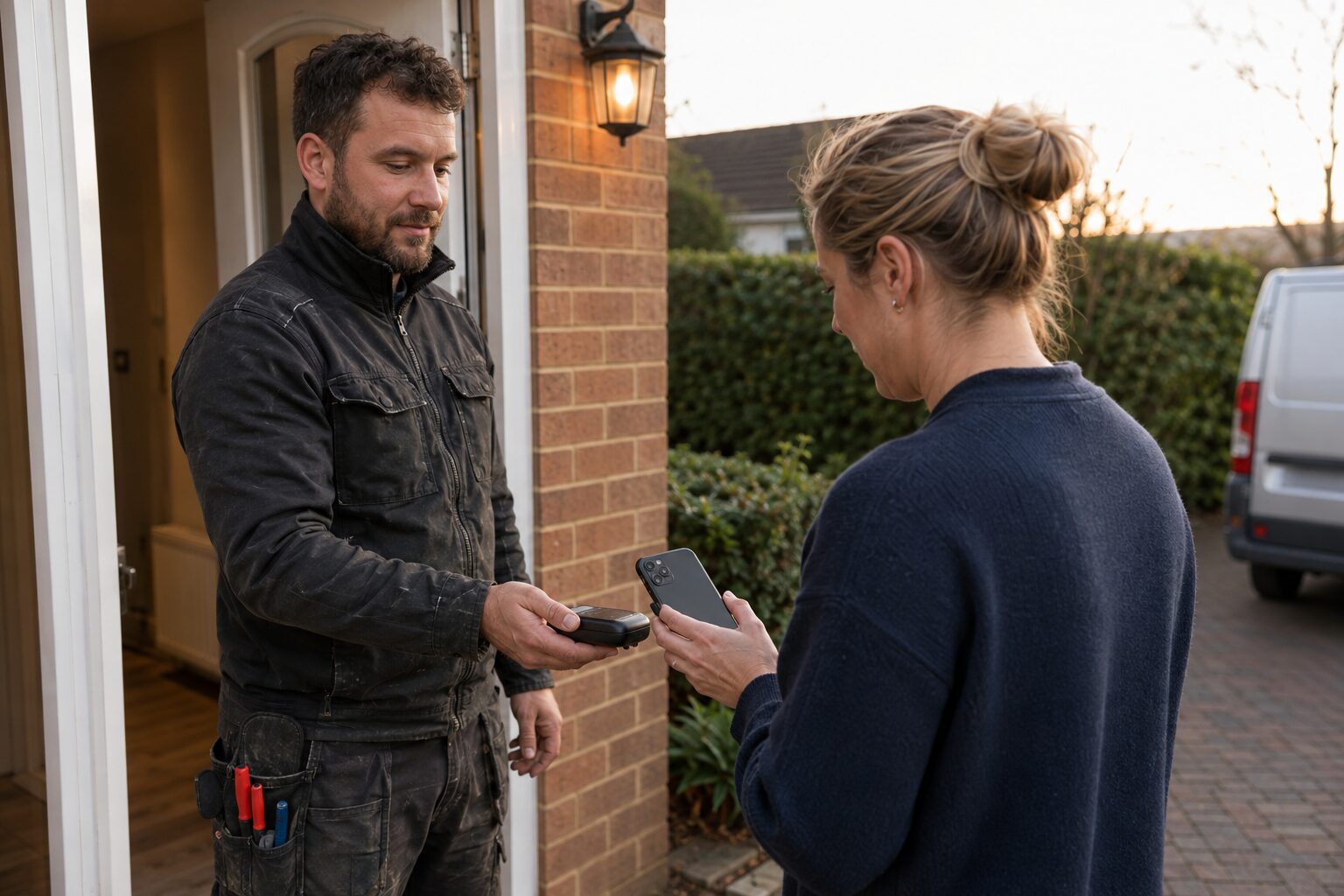
A card reader takes a card-present payment. The customer’s card or phone touches a physical reader connected by Bluetooth, and the payment authorises in seconds while the engineer is still on site. This is the doorstep transaction: job finished, card tapped, done before the van pulls away.
A payment link takes a card-not-present payment. The customer receives a link by text or email, usually attached to an invoice, and pays it in their own time from their own phone or laptop. This is the transaction that happens after the visit, when the invoice has line items, VAT, and sometimes a part the customer wants to query before paying.
A trade business that only fits kitchens and takes payment at completion mostly needs a reader. A business that quotes, then orders parts, then invoices a week later mostly needs a link. Many trades need both, which is why the provider that wins on reader fees is not always the one that wins on link fees.
What do SumUp, Stripe, Square, Zettle and Tide charge in 2026?
Rates checked live on each provider’s own UK pricing page on 4 September 2026. Card-present figures are the reader rate; card-not-present figures are the payment link or online rate. Where a provider offers a cheaper rate for a monthly subscription, both figures are shown.
| Provider | Card-present (reader) | Card-not-present (link/online) | Monthly fee | Settlement | Reader price (from) |
|---|---|---|---|---|---|
 |
0% on a SumUp card, 1.69% on other cards (pay as you go); 0.99% domestic debit/credit on the £19/month Payments Plus plan [3] | 2.5% on both plans [3] | £0, or £19/month (£189/year) for Payments Plus [3] | Funds land in the SumUp Business Account by 7am the next day, including weekends [3] | £25 (Solo Lite) [4] |
 |
1.4% + 10p on EEA cards, 2.9% + 10p on non-EEA cards, via a card reader [1] | 1.5% + 20p standard UK cards, 2.8% + 20p premium UK cards, 2.5% + 20p EEA cards, 3.15% + 20p international cards, plus 2% if currency conversion applies [1] | £0 [1] | First payout typically 7 days after the first successful payment and a linked bank account, then on the rolling, weekly or monthly schedule set on the account; an instant payout option costs 1% with a 40p minimum [1][2] | Quote only, sold via Stripe’s Terminal hardware partners [1] |
 |
1.75% on UK cards, 1.75% + 1.5% on non-UK cards | 1.4% + 25p on UK cards, 2.5% + 25p on non-UK cards; 2.5% flat on manually keyed cards [5] | £0 on the Free plan; from £29/month on the Plus plan [5] | 1 to 2 working days free by bank transfer, or instant for a 1.5% fee [5] | £19 + VAT (Reader) [5] |
 |
1.75% flat, all major cards and mobile wallets including Amex [6] | 2.5%, but payment links are temporarily unavailable to new sellers while PayPal makes product changes, quote only until that reopens [6] | £0 [6] | Funds appear in the PayPal Business balance within minutes; bank transfer out carries no added fee but PayPal does not publish a fixed number of days for that transfer [6] | £29 + VAT [6] |
 |
1.5% + 5p pay as you go; 0.89% + 3p on the £17.99 + VAT/month Sell In-Person plan [7] | 1.5% + 9p pay as you go; 0.79% + 9p on the £6.99 + VAT/month Sell More Online plan [8] | £0, or a paid plan for the lower rate [7][8] | 3 working days standard on card reader payments, next business day for £2.99 + VAT/month extra; payment links settle in 1 to 3 business days standard [7][8] | £159 + VAT (Card Reader) [7] |
A reader needs a bank account to receive its own payouts, and Tide’s rates above assume a Tide business account. SumUp, Zettle and Square each run their own included payments balance; Stripe pays out to whichever UK bank account is connected.
Which provider fits which kind of trade business?
SumUp: the simplest choice for occasional, low-value card taps
SumUp’s pay as you go plan has no monthly fee, and a next-morning settlement that lands by 7am even on weekends [3]. That combination suits a sole trader who takes a handful of card payments a week and wants the cheapest possible entry point. The £19 a month Payments Plus plan only earns its keep once transaction volume on domestic debit and credit cards is high enough that the 0.99% rate saves more than £19 [3]. A trade taking a couple of card payments a week has no reason to pay for it.
Stripe: the choice for a business running software around the payment
Stripe’s own reader rates are close to the cheapest on this list for EEA cards [1], but the real reason trades pick Stripe is the payment link and API layer sitting underneath it. Its pricing includes no separate charge for sending a payment link; the same rate applies whether the customer pays by link or in the app [1]. That makes Stripe the natural fit for a business whose invoicing software, Checker included, already builds the pay link into the invoice itself rather than sending the customer somewhere else.
Square: the choice for a business that wants software and payments from one vendor
Square’s free plan carries no monthly fee, and its online card rate, 1.4% + 25p on UK cards, undercuts several competitors on that specific transaction type [5]. Square also sells its own point-of-sale software, stock control and staff scheduling around the reader, so it suits a growing trade business that wants one login for the till and the books rather than stitching a payments account into separate job management software.
Zettle: the established doorstep reader, with a caveat on links right now
Zettle’s flat 1.75% reader rate applies to every major card and mobile wallet, including American Express, with no separate premium-card surcharge [6]. That flat, simple rate is why it remains a common default for a trade taking cards on site. Its payment link product is not currently available to new sellers while PayPal makes changes to it [6], so a business that specifically needs card-not-present links today should check that page again before signing up, or choose a different provider for that half of the job.
Tide: the choice for a business already banking there
Tide is a business bank account first, with card payments added on top, and its rates are among the highest on this list on the pay as you go tier, 1.5% + 5p on a reader and 1.5% + 9p on a link [7][8]. Both rates roughly halve on a paid subscription, £17.99 + VAT a month for in-person, £6.99 + VAT a month for links, and Tide’s own guidance is that the subscription pays for itself once monthly card takings pass roughly £2,900 [7]. For a trade business that already holds its current account at Tide, taking payments through the same app avoids a second login and a second settlement account, which is worth something even where the headline rate is not the cheapest.
Where does Checker fit into this?
Checker is not a payment provider and does not appear in the table above. It is job management software that connects to two of the providers in it rather than competing with either.
On site, Checker sends the amount due to a Zettle card reader over Bluetooth, the customer taps or inserts their card, and the invoice marks itself paid automatically once Zettle confirms the transaction [10]. The card fee for that payment is billed by Zettle at Zettle’s own rate, not by Checker, and Checker takes no cut of it [10].
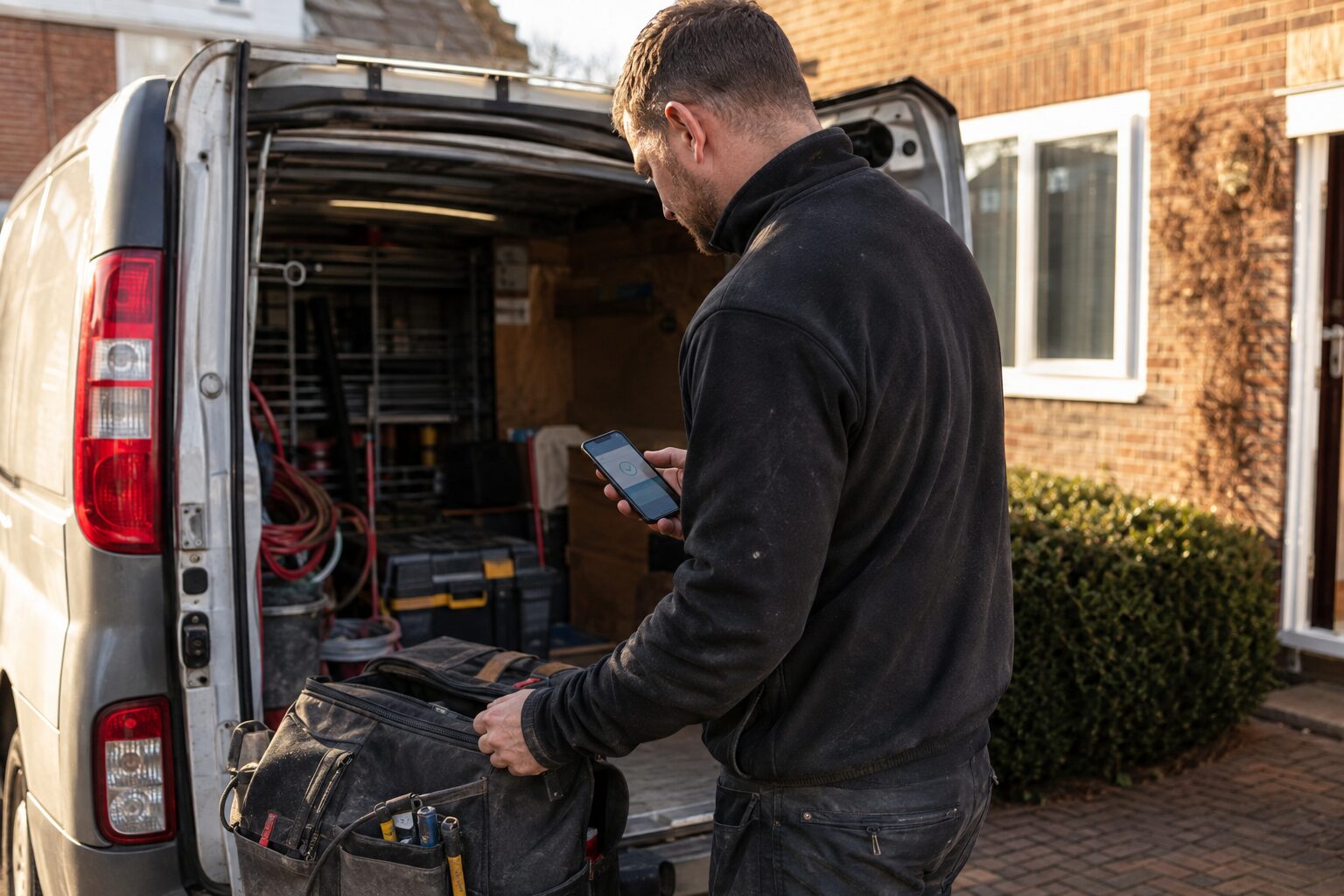
For invoices paid later, Checker connects to a Stripe account and adds a pay link to the invoice, so a customer can pay by card, Apple Pay or Google Pay straight from the email or PDF, with the invoice flipping to paid automatically once Stripe confirms it [9]. That integration is in beta and is currently set up and managed from the Checker web app rather than the phone app, though an invoice sent from the phone still carries the pay link once the Stripe account is connected [9]. Stripe’s own rates from the table above apply, again with no separate charge added by Checker.
In practice this means the choice of payment provider and the choice of job management software are two separate decisions. A trade business picking a card reader or a pay link provider from the table above can still run Checker on top of it for the invoicing, chasing and record-keeping around that payment. Checker’s own pricing covers the LITE, PRO and PRO+ plans that this invoicing and record-keeping runs on.
Frequently asked questions
Do any of these providers charge a monthly fee just to hold an account?
No. SumUp, Stripe, Square, Zettle and Tide all offer a pay as you go tier with no monthly account fee, charging only a percentage on each transaction. A monthly fee only appears where a provider offers a lower transaction rate in exchange for it, such as SumUp’s Payments Plus, Square’s Plus plan, or Tide’s Sell In-Person and Sell More Online add-ons [3][5][7][8].
Which provider settles fastest to a bank account?
Zettle’s balance updates within minutes inside the PayPal Business account, though the further transfer out to a UK bank is not given a fixed number of days on Zettle’s own pricing page [6]. SumUp is the fastest with a stated deadline, landing by 7am the next day including weekends [3]. Square offers free settlement in 1 to 2 working days [5]. Tide’s standard settlement is 3 working days on card reader payments and 1 to 3 business days on payment links, both reducible with a paid add-on [7][8].
Can a trade business use a different provider for the reader and for payment links?
Yes, and the fee comparison above is a reason some do. A business might take a Zettle reader on site for its flat 1.75% rate and route invoice pay links through Stripe or Tide, rather than assuming one provider has to cover both.
Does the card fee change if the customer pays with American Express or an international card?
Usually, yes. Stripe, SumUp and Square all charge a higher rate for premium, international or non-UK cards than for a standard domestic debit or credit card [1][3][5]. Zettle is the exception on its reader: its flat 1.75% rate applies to Amex the same as any other major card [6].
Authoritative sources
- Stripe UK pricing, Stripe, checked 4 September 2026
- Waiting period for first payout on Stripe, Stripe Support, checked 4 September 2026
- SumUp UK pricing, SumUp, checked 4 September 2026
- SumUp card machine, SumUp, checked 4 September 2026
- Square UK pricing, Square, checked 4 September 2026
- Zettle UK pricing, PayPal Zettle, checked 4 September 2026
- Tide card reader, Tide, checked 4 September 2026
- Tide payment links, Tide, checked 4 September 2026
- Stripe integration, Checker, checked 4 September 2026
- Take a card payment, Checker, checked 4 September 2026
Get paid faster on every job
Run invoicing, chasing and record-keeping around whichever card payment provider you pick.