
The Unvented Cylinder (G3) Record: What to Write and When the Next Service Is Due (UK, 2026)
What should a plumber record for an unvented cylinder? The commissioning and notification details at install, each annual service against the maker's interval, and the next due date, all on the property record.

Updated 23 November 2026
TLDR: Keep every unvented cylinder as a dated record on the property. At install, record the commissioning checks, the Benchmark checklist and the Building Regulations notification. Each year, record the relief valve test, expansion check, strainer and seals against the manufacturer's interval, and set the next due date before you leave.
When a landlord rings because a new tenant has seen water running from the tundish, the first thing anyone asks is when the relief valves were last tested. On a six-year-old cylinder the answer is often a shrug. The commissioning sheet sits in the back of a booklet in the airing cupboard, and nobody wrote the later services down anywhere the landlord or the next engineer can find.
For unvented hot water, the record carries more risk than the visit. A discharge test that was never recorded looks exactly like one that was never done, and makers such as Heatrae Sadia and Joule tie their cylinder warranties to annual servicing. The fix is simple: one record per cylinder, filed against the property, with commissioning at the top, a dated entry for every service and the next due date on it.
Keep each cylinder's G3 record and commissioning record against the property in Checker, and set a service reminder from the job.
Who can install an unvented cylinder, and what must be recorded at commissioning?
Fitting an unvented cylinder is notifiable building work in England, so either you notify building control before you start or you self-certify through a competent person scheme. Approved Document G says this in paragraphs 3.41 and 3.42, and it is the reason the commissioning record matters from day one.
The legal requirement is Part G3 of Schedule 1 to the Building Regulations 2010. A hot water system with a storage vessel must stop the stored water ever going above 100°C, and any discharge from the safety devices must be carried to where it is visible but safe. Approved Document G turns that into practice for cylinders up to 500 litres and 45kW:
- Two independent safety devices on top of the thermostat, typically a non self-resetting energy cut-out and a temperature and pressure relief valve.
- A proprietary unit or package, marked with the maker, model, capacity, operating pressures and safety device data.
- A tundish in the same space, with no more than 600mm of pipe between the valve and the tundish, and any discharge visible there.
- A warning label that names the installer and the completion date, and tells the user to switch off and call the installer if hot water flows from the discharge pipe.
That label is the first record most homeowners ever see, and it already points them back to you.
Notification is the second record. If you are registered with a competent person scheme for unvented hot water, you self-certify and the homeowner gets a Building Regulations compliance certificate, usually issued by the scheme operator. Under a scheme, the scheme gives the commissioning notice for you, within 30 days of completion (Approved Document G 3.78 and 3.79). Where building control is handling it, the limit is 5 days.
Schedule 3 to the 2010 Regulations lists the bodies whose members can self-certify a heating or hot water system, and GOV.UK keeps the current list of competent person schemes, last updated on 17 September 2026. Approved Document G also names a current registered operative skills card for unvented systems as evidence that an installer has the skills.
The third record is the Benchmark commissioning checklist. Benchmark, which the Megaflo manual says the Heating and Hotwater Industry Council manages and promotes, says completing its checklist is a way of meeting the commissioning requirements in Part L, and cylinder makers print it in their manuals. Heatrae Sadia's Megaflo Eco installation manual says the checklist should be given to the customer for future reference, and lists a completed Benchmark commissioning checklist and service record among its warranty conditions. For the boiler side of the same install, see our boiler installation paperwork checklist.
What does an annual unvented service check?
An annual unvented service tests the safety devices, cleans the strainer, checks the expansion space and the seals, and gets written up on the Benchmark service record. Neither the Building Regulations nor Approved Document G set a yearly service interval for a homeowner's cylinder. The yearly interval comes from the manufacturers, and their warranties make it hard to ignore.
Two makers' published instructions, checked on 22 November 2026, show the pattern:
- Heatrae Sadia, Megaflo Eco: the installation manual says maintenance checks should be done by a competent person annually, for example alongside the boiler service, with the Service Interval Record section of the Benchmark checklist completed after any maintenance. The warranty conditions include seals checked at an annual service and regular maintenance done as the manual sets out.
- Joule, Cyclone: the Joule warranty certificate makes the 25-year vessel guarantee conditional on the unit being serviced annually and the service log book being completed after each service, and warns that servicing invoices may be requested as proof. Joule's UK knowledge base tells homeowners to keep proof of annual maintenance.
The Megaflo Eco manual lists what the visit covers:
- Operate the temperature and pressure relief valve for a few seconds, check the water flows freely through the tundish and discharge pipe, and check the valve reseats. The discharged water can be very hot, so keep clear of the tundish.
- Repeat for the expansion relief valve.
- Clean the strainer in the pressure reducing valve.
- Check the expansion space. On the Megaflo Eco this is an internal air volume that needs recharging when the expansion valve discharges intermittently. Other cylinders use an external expansion vessel with its own charge pressure.
- Descale the immersion heater where needed, and check the seals.
Each of those checks needs a line on the record, with what you found and what you did. A relief valve that reseated after a test and one that was replaced look the same in a year's time unless somebody wrote it down.
Intervals and checks differ by model, so read the instructions for the cylinder on the wall. Makers change their terms over time, so a newer Megaflo or Joule cylinder may carry different conditions from the ones described here. Where a manufacturer or warranty sets a different interval, the record follows that interval.
What should each cylinder's record hold?
Each cylinder's record should hold what you would need to take over the job cold: what was fitted, how it was set up, who signed it off, and every service since. Here is the field list we would use, built from Approved Document G, the Benchmark checklist and the two manufacturers above.
| Record field | What to write | Why it matters |
|---|---|---|
| Cylinder identity | Make, model, capacity, serial number, location | Matches the manual and warranty |
| Commissioning | Date, installer, Benchmark checklist completed | Dates the install for warranty checks and the first service |
| Notification | Scheme or building control, reference, date | Shows the work was notified and certified |
| Safety devices | Relief valve settings, cut-out, tested or replaced | Shows the devices worked when checked |
| Expansion | Vessel charge or air volume recharged | Intermittent discharge can point to it |
| Strainer and seals | Cleaned, checked, replaced | Named in warranty and service steps |
| Discharge route | Tundish visible, discharge pipe clear | Discharge must be safe and visible |
| Next service due | Date, set from this visit | Keeps the annual pattern intact |
Cylinder identity
What to write: Make, model, capacity, serial number, location
Why it matters: Matches the manual and warranty
Commissioning
What to write: Date, installer, Benchmark checklist completed
Why it matters: Dates the install for warranty checks and the first service
Notification
What to write: Scheme or building control, reference, date
Why it matters: Shows the work was notified and certified
Safety devices
What to write: Relief valve settings, cut-out, tested or replaced
Why it matters: Shows the devices worked when checked
Expansion
What to write: Vessel charge or air volume recharged
Why it matters: Intermittent discharge can point to it
Strainer and seals
What to write: Cleaned, checked, replaced
Why it matters: Named in warranty and service steps
Discharge route
What to write: Tundish visible, discharge pipe clear
Why it matters: Discharge must be safe and visible
Next service due
What to write: Date, set from this visit
Why it matters: Keeps the annual pattern intact
Who gets a copy depends on who owns the cylinder. The homeowner keeps the manual and the completed Benchmark pages, as the Megaflo manual asks. For a let property, send the landlord or agent a copy of each service entry. They are the ones a tenant calls when the tundish starts running.
Keep your own copy on the property record too, so the next engineer from your firm can see the history before arriving.
How do you stop the next service slipping?
Set the next due date on the record before you leave, then let a reminder prompt the booking a month ahead. A reminder makes nobody compliant and does no service; it only gets the customer to book in.
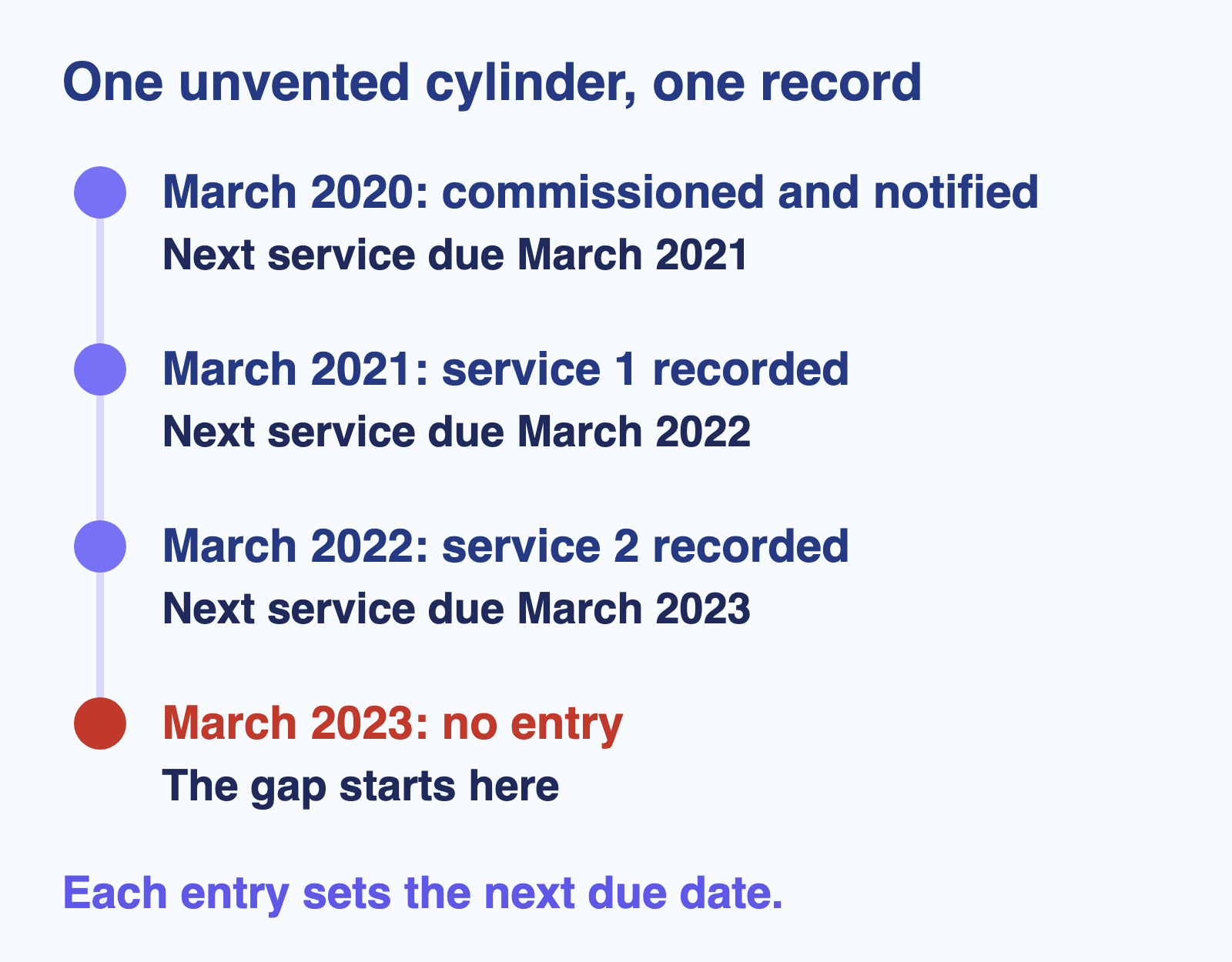
Here is a worked example with labelled dates, as at 22 November 2026, for a cylinder like the one in the opening:
- The cylinder was commissioned on 9 March 2020, with a completed Benchmark checklist.
- Six annual services fell due between March 2021 and March 2026.
- The record shows services in March 2021 and March 2022, so four years have no entry.
- You attend on 24 November 2026, test both relief valves, recharge the expansion space and record it.
The landlord now has two problems. The fault needs putting right, and four missing years may sit badly against a warranty that asks for annual servicing and proof. From your visit, the next service falls due by 24 November 2027. With an 11-month reminder trigger, the customer hears from you around 24 October 2027, a month before it is due.
When does this record not apply?
This record pattern does not apply to vented cylinders or combi-only homes. A vented cylinder is fed from a cold water cistern and open to the atmosphere. It has no unvented relief valves or expansion device to test, and the unvented notification paragraphs in Approved Document G do not cover it. A standard combi boiler has no cylinder, and the small stores in some combis fall under the 15-litre point below.
Two more cases change the pattern:
- Small water heaters. Approved Document G says heaters of 15 litres or less with suitable temperature and pressure devices will generally meet G3(3), and the Water Supply (Water Fittings) Regulations 1999 leave instantaneous heaters of that size out of their relief valve paragraph.
- Firms that install and never service. Your record ends at commissioning and notification. Hand the customer the completed Benchmark pages and tell them, in writing, that the maker expects an annual service by someone else.
Do the rules differ in Scotland, Wales or Northern Ireland?
Yes, each nation sets its own building rules, though the safety devices are the same. Wales has its own Approved Document G. Northern Ireland's Building Regulations 2012 cover unvented systems over 15 litres in regulation 88. Scotland's domestic Technical Handbook, under standard 4.9, says unvented installers should have appropriate training and that safety devices should be maintained. The record fields above work in all four nations.
Where does Checker fit?
Checker keeps the cylinder's paperwork on the property it belongs to. Our customer database stores one customer with as many properties as they own, and each property has its own appliance list, certificate history and service reminders.
For unvented work we produce two records: the Domestic Unvented Hot Water Storage Vessel Record (G3) and a legacy Unvented Cylinder Commissioning (G3) form, alongside our Benchmark Boiler Commissioning record and job sheets. Our plumbing and heating page describes the unvented commissioning record as done before you leave site, with a branded PDF to the customer.
Plans, as at 22 November 2026: annual service reminders and the customer database come with PRO at £19.99 a month plus VAT and PRO+ at £25.99 a month plus VAT, according to our pricing page. Lite at £10.99 a month plus VAT has no CRM, reminders or accounts sync. A year of PRO paid monthly is £239.88 plus VAT, or £199.99 plus VAT paid annually.
Reminders fire 11 months after the job by default, and you can change the default and override it on any single reminder. They go by email, SMS or a printed letter, and SMS uses text credits. Our guide to setting up boiler service reminders walks through the same set-up for boilers.
Checker does not notify building control or a competent person scheme for you, so keep notifying through your scheme as you do now. If you are still choosing a plumbing app, our best apps for plumbers in the UK guide compares the wider options.
What should you write down on the next unvented job?
Before you pack up on the next unvented cylinder, check five lines on the record:
- Make, model, serial and location of the cylinder.
- Commissioning date, Benchmark checklist completed, notification reference.
- Each safety device tested, with the result.
- Expansion, strainer and seals checked, with anything replaced.
- Next service due date, with the reminder set.
Put your next unvented cylinder on the property record in Checker, with its G3 record and commissioning record, and a service reminder set from the job (PRO and PRO+).
Frequently asked questions
Is an annual unvented cylinder service a legal requirement?
Neither the Building Regulations nor Approved Document G set a yearly service for a homeowner's cylinder. Manufacturers such as Heatrae Sadia and Joule recommend or require annual servicing, and their warranties depend on it. Scotland's Technical Handbook says safety devices should be maintained.
Do I need to notify building control if I replace an unvented cylinder?
Yes, in England, unless you are registered with a competent person scheme covering unvented hot water. Then you self-certify, the scheme notifies, and the homeowner gets a compliance certificate.
What does a discharge at the tundish usually mean?
Hot water from the discharge pipe points to a fault, and the cylinder label tells the user to switch off and call the installer. Intermittent discharge from the expansion valve on a Megaflo Eco means the expansion air volume needs recharging.
Who keeps the Benchmark checklist?
The customer keeps it with the installation manual, and the engineer completes the service record section after each service. Keep your own copy on the property record as well.
Does a service reminder make the landlord compliant?
No. A reminder prompts the booking. The service, the record and any repairs still have to be done.
Further reading
Authoritative sources
- GOV.UK: Approved Document G, sanitation, hot water safety and water efficiency (updated 1 October 2024)
- Approved Document G with 2024 amendments, paragraphs 3.17 to 3.24, 3.40 to 3.42 and 3.77 to 3.80 (PDF)
- Building Regulations 2010, Schedule 1, Part G3
- Building Regulations 2010, Schedule 3, self-certification schemes
- GOV.UK: competent person schemes, current schemes (updated 17 September 2026)
- Water Supply (Water Fittings) Regulations 1999, Schedule 2
- Benchmark scheme
- Heatrae Sadia: Megaflo Eco installation manual, maintenance and warranty sections (PDF)
- Joule: unvented cylinder warranty certificate (PDF)
- Joule UK: unvented cylinders annual service checklist
- Welsh Government: Approved Document G
- Building Regulations (Northern Ireland) 2012, Part P, regulation 88
- Scottish Government: Building standards technical handbook 2023, domestic, addendum PDF, standard 4.9
- Checker plumbing and heating software, United Kingdom
- Checker customer database: multiple properties per customer
- Checker annual service reminders
- Checker pricing, checked 22 November 2026
- Checker plumbing software