CIS Deduction or Short Payment? How to Check a Trade Invoice Against the Contractor’s Statement (UK, 2026)
Match a UK trade invoice to the cash received and the contractor’s CIS statement. Check a worked example and see what to ask for when the figures differ.

TLDR Match the invoice you sent, the money that reached your bank and the contractor’s Construction Industry Scheme (CIS) payment and deduction statement. Use the contractor’s payment breakdown to link any monthly totals to your invoice. Once you can account for the cash and the documented deduction, record any difference that still needs explaining.
Published
You sent a £1,200 invoice for pipework on a site refit. The contractor transferred £950 with a reference that just says “October payment”. Before you chase £250, find out which invoice the transfer paid and how much the contractor actually deducted. If you jump straight from the bank amount to the invoice balance, it’s easy to chase the wrong figure and leave the bookkeeper with the same question at month end.
Start with the fields the contractor can recognise on the invoice: its unique number, both businesses’ names and addresses, the work and supply date, the invoice date, the charges, any applicable VAT and the total owed. Show labour and materials separately so the contractor can check eligible direct costs against the receipts. The contractor works out the CIS deduction when paying you and records it on their payment and deduction statement. See GOV.UK’s full list of invoice requirements.
What do the three records tell you?
The invoice shows what you billed, the bank shows what arrived and the contractor’s payment and deduction statement shows what they paid before CIS and how much they deducted. Start with the issued invoice, even if your job app has a newer quote or an open balance on screen.
Issued invoice and supporting receipts. Find the contractor’s billing name, invoice number, job reference, amount due, line items and VAT treatment. Pull the supplier receipts for materials you paid for directly for that contract. The line item tells you what you billed for materials. The receipt helps show what you actually paid, which is the figure to check against the contractor’s materials allowance. HMRC’s contractor guidance explains what can be excluded when calculating a CIS deduction.
Bank receipt. Record the amount that arrived, the date, the payer name and any payment reference. The reference might be a payment run number covering several jobs. Save the accompanying remittance advice, the contractor’s breakdown of where the payment went, if they sent one.
Contractor’s statement. Check the contractor and subcontractor named, the tax month or individual payment date, gross payments before CIS and excluding VAT, the materials figure used in the calculation and the CIS deducted. The statement records payments the contractor says they made. The amount billed on an invoice can differ from the gross payment reported. The statement may give additional information such as VAT. HMRC’s CIS 340 guide sets out the statement fields in section 3.15 and shows a specimen in Appendix E.
How do you match a CIS payment to an invoice?
Match the contractor and the payment period first. Then use the invoice number or a written payment allocation to connect the cash and deduction to the job. A CIS tax month runs from the sixth of one month to the fifth of the next. Use the date the contractor made the payment to identify the statement period. If the bank date and the remittance date straddle the fifth, ask which period the contractor used. See HMRC’s guidance on checking payment and deduction statements.
- Put the records side by side. Open the issued invoice, the incoming bank entry and the contractor’s statement. Add the remittance and direct materials evidence if you have them.
- Confirm which invoice the payment covers. Match the contractor and payment period, then look for the invoice reference on the remittance. For a batch or part payment, ask for the amount before deduction, the CIS taken and the cash allocated to the invoice.
- Check the deduction and the cash separately. Compare the statement’s payment and materials figures with the allocation and the job evidence. Use the invoice’s VAT treatment to establish the amount due, then compare the cash allocated and the documented CIS with that amount.
- Record what still needs explaining. Keep the source documents together, note any difference and give the bookkeeper the contractor’s written explanation or correction when it arrives.
A contractor may issue one statement for several payments made in the tax month. Two transfers that add up to a monthly total can help you confirm the month, but you still need to know how those transfers were split between invoices. Ask for the breakdown by invoice or payment reference if the documents leave it unclear. Keep a separate record for each contractor, even if two contractors paid you for work on the same site.
What does a £950 receipt against a £1,200 invoice tell you?
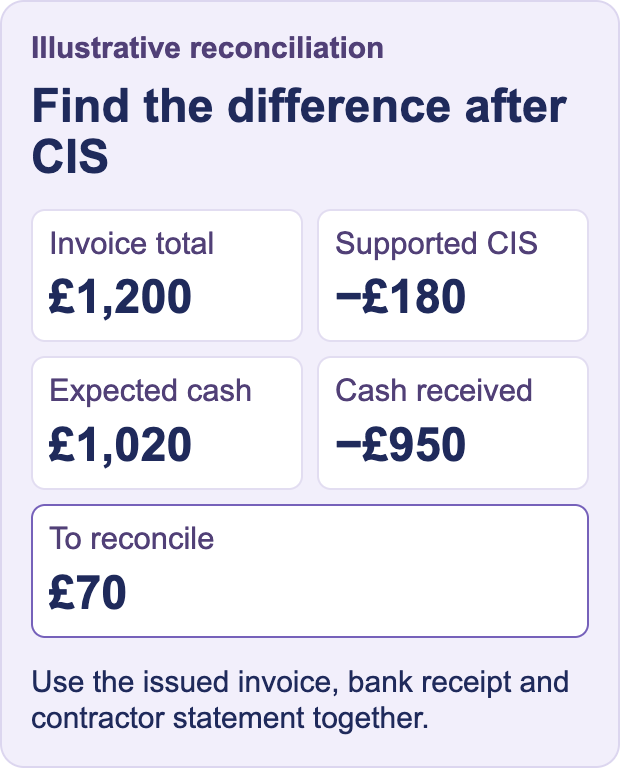
If the contractor can show that £180 of CIS relates to this invoice, the £950 receipt and the deduction account for £1,130. There’s still £70 to explain. That conclusion depends on matching both amounts to the same invoice.
Worked example. These are illustrative figures. Invoice 1042 bills £900 for labour and £300 for qualifying materials the subcontractor paid for directly. Assume the £300 is the actual eligible cost excluding VAT, HMRC has set a 20% deduction rate for the subcontractor, and the VAT domestic reverse charge applies to this supply. The contractor accounts for the VAT, so the invoice amount payable before CIS is £1,200. Check when the VAT reverse charge applies and see HMRC’s explanation of its effect on cash payments.
| Record | Figure for invoice 1042 | What to check |
|---|---|---|
| Issued invoice and receipts | £1,200 payable before CIS, including £300 of qualifying materials | The materials receipts support the £300. The contractor accounts for the reverse-charge VAT. |
| Contractor’s statement and allocation | £1,200 reported as paid before CIS, £300 materials and £180 CIS attributed to this invoice | £1,200 less £300 leaves £900 subject to CIS. At 20%, the deduction is £180. |
| Bank and payment reference | £950 received and matched to invoice 1042 | The cash expected from that breakdown is £1,020. The receipt leaves £70 unresolved. |
The £300 comes out of the calculation of the deduction. It’s still part of the £1,200 due before CIS. If the contractor had paid £1,020 into the bank and the paperwork agreed, the full amount would be accounted for. With £950 received, ask why the contractor’s breakdown implies £1,020 in cash and whether another transfer was made. Keep the £70 open while the contractor and bookkeeper trace it. If there was no further transfer, query the statement’s reported gross payment and ask the contractor to confirm the amount actually paid before CIS and correct the statement if needed. If the contractor only processed part of the invoice, ask for the payment and deduction figures for that part. See the CIS rules on deduction rates and payment evidence.
Which VAT figure belongs in the cash check?
If ordinary VAT is charged on the invoice, check the amount due including VAT when you compare the expected and actual cash. VAT charged stays outside the CIS calculation. If the invoice’s VAT treatment itself is in question, pass the original and the query to the bookkeeper before changing anything. Checker’s guide to VAT, CIS and the reverse charge shows how the different treatments appear on a trade invoice.
On a UK domestic reverse-charge invoice, keep the usual VAT invoice details. State that the reverse charge applies and the customer accounts for VAT. Show the VAT amount, or the rate if you can’t show the amount, separately from the amount you charge. When comparing trade invoicing apps, ask to see the issued invoice and check that you can tell the cash due from the VAT the customer accounts for. Then check what the plan costs with any separate bookkeeping subscription your office needs. Read HMRC’s reverse-charge invoice requirements.
Checker’s UK pricing lists current prices for LITE, PRO and PRO+, all of which include invoicing. Checker’s Quotes & Invoices feature supports line-item VAT and domestic reverse-charge wording where applicable. If your office already uses Xero, two-way invoice and payment sync is available on PRO and PRO+. Include the separate Xero subscription in your comparison, and agree with your bookkeeper how to record deductions and retain contractor statements.
What should you do when the figures still don’t agree?
Send the contractor the specific payment date, invoice reference and figure you need explained. An accounts team can act on a request for the allocation of a named transfer. “The money looks short” leaves them to start the check again.
| What you find | What to ask for or keep |
|---|---|
| The cash and documented CIS account for the invoice | Keep the issued invoice, payment reference and contractor’s statement together for bookkeeping. Record any allocation that was needed to connect them. |
| A statement is due but hasn’t arrived | Check the tax month and ask the contractor for the statement or a replacement. When they make deductions, the statement is due within 14 days after the tax month ends. |
| The statement groups several payments or shows an unexpected figure | Ask the contractor for the invoice allocation and a written explanation of the gross payment, materials and deduction. Ask for a corrected statement if the contractor confirms the figures are wrong. |
| Cash and the documented deduction still leave a difference | Record the unresolved amount against the invoice. Ask if more cash was sent separately or if there’s an open balance. Share the reply and evidence with the bookkeeper before treating the difference as settled or as CIS. |
When the cash and documented deduction account for the invoice, have the bookkeeper match the bank receipt and record the CIS withheld separately against that same invoice using the accounting package’s CIS workflow. If the receipt is already matched, record only the supported deduction. Leave any genuine remainder open until it’s explained.
What if the contractor can no longer issue a statement?
If the contractor can’t provide the statement, for example because they’ve gone out of business, follow GOV.UK’s missing-statement route to write to HMRC. Have your UTR and the contractor’s details to hand, along with the payment dates or tax months and the reason you can’t get the paperwork. Keep the bank records, invoices and correspondence with the query. HMRC’s staff guidance explains what payment information they may ask for.
If a contractor sent a slip showing only the amount deducted, ask for the full statement with their name and employer tax reference, your business name and UTR, the payment period or date, and the gross payment, materials and deduction figures. If the contractor took the higher rate because they couldn’t verify you, the statement should also show the verification number. To link the records, start with the contractor name, invoice number, gross invoice amount and VAT treatment. Match them to the dated bank entry, cash amount and payment reference. Use the contractor’s remittance to confirm the invoice allocation, the payment date or tax month and the deduction shown on a usable statement. HMRC follow-up can help confirm the amount when the statement remains unavailable. See the required statement fields.
The contractor is responsible for the deduction statement and their monthly CIS return. Your bookkeeper needs the evidence to record the receipt and deductions on your side. GOV.UK sets out how subcontractors report deductions, with different routes for sole traders, partnerships and limited companies.
What should a VAT and CIS invoicing app hand over?
Test whether someone in the office can open the actual invoice sent for a job and hand it to the bookkeeper with enough information to match a payment. Give them a job reference, then see if they can find the invoice number, contractor name, line-item split and the VAT treatment shown on the document. Use a job where the contractor’s payment covers more than one invoice if you have one.
Checker’s Quotes & Invoices feature lets trade businesses issue invoices against jobs, with a line-item breakdown and wording for CIS or the VAT domestic reverse charge where applicable. For the bookkeeping handover, agree where to keep the contractor’s statement, remittance and materials evidence. Use the accounting system or a separate shared record for the allocation and unresolved amount if that’s where the bookkeeper checks them. A useful handover lets the next person open the evidence without asking the engineer to reconstruct the job from memory.
If a payment was planned in stages, check the agreed stages and invoice trail before chasing a balance. If you’re still choosing a system, Checker’s VAT and CIS invoicing app guide covers the difference between trade invoicing and full bookkeeping.
Start with one recent contractor transfer. Pull the original invoice and statement, write down how much cash and documented CIS belong to that invoice, and give any unexplained figure a named person to follow up.
Authoritative sources
Check the requirement against the document you’re looking at. The sales invoice identifies the work and amount charged, including how VAT applies. The contractor then checks qualifying direct materials and applies the HMRC rate to the eligible payment excluding VAT. The contractor’s statement records the gross payment, qualifying materials used and actual deduction. Start with the GOV.UK invoice checklist for the sales document and CIS 340 for the contractor’s statement.
- GOV.UK checklist of required invoice details
- HMRC guide to calculating and making CIS deductions
- HMRC CIS 340 guide to statement fields and timing
- HMRC manual on checking payment and deduction statements
- GOV.UK guide to when the VAT domestic reverse charge applies
- HMRC technical guide to reverse-charge VAT and cash flow
- GOV.UK guidance for subcontractors on deductions and missing statements
- HMRC guidance on missing payment and deduction statements
- GOV.UK guidance on the contractor’s monthly return
- GOV.UK guidance on reporting subcontractor deductions
Use Checker Quotes & Invoices to issue itemised invoices from the job so the office has the invoice reference and line items for the handover.
Get Started FreeFrequently asked questions
Can I use a bank transfer reference as evidence of a CIS deduction?
Use it to identify the receipt. For the amount deducted, use the contractor’s payment and deduction statement and any allocation needed to link it to the invoice. Even if the bank reference says “CIS”, it can’t tell you how the contractor calculated or reported the deduction.
What if the contractor sends a replacement statement and I find the original later?
HMRC tells contractors to mark replacement statements as duplicates. Check that the contractor, period and figures match, and record the deduction once. If the figures differ, ask the contractor which document reflects the payment before your bookkeeper uses it.
One transfer covers several invoices. Can I split it in proportion to the invoice values?
Ask the contractor for the actual allocation. Invoices can have different eligible materials costs, and a payment run may include only part of an invoice. A proportional split can leave the wrong job looking fully paid.
What should the office send to the bookkeeper if the job app shows a payment?
Send the issued invoice, the bank reference, the contractor’s statement and the remittance or written allocation. Include the materials receipts if they explain the deduction calculation. Put any unanswered question alongside the figures so the bookkeeper knows what still needs checking.

Certificates, quotes and invoices done on site, then service reminders that bring the work back.
Same app everywhere. We show local paperwork, tax and terms, and remember your choice.