
Gas Warning Notice on a Landlord Safety Check: What to Record When an Appliance Is Immediately Dangerous or At Risk (UK, 2026)
An appliance fails the landlord gas safety check. How to classify it as Immediately Dangerous or At Risk, what the warning notice and CP12 must record, and who gets a copy.
Updated 23 November 2026
TLDR: When an appliance fails a landlord gas safety check, classify it as Immediately Dangerous or At Risk under IGEM/G/11, make it safe with permission, label it, and complete a separate warning notice signed by the tenant. Record the defect and action on the landlord gas safety record too, and tell the landlord in writing.
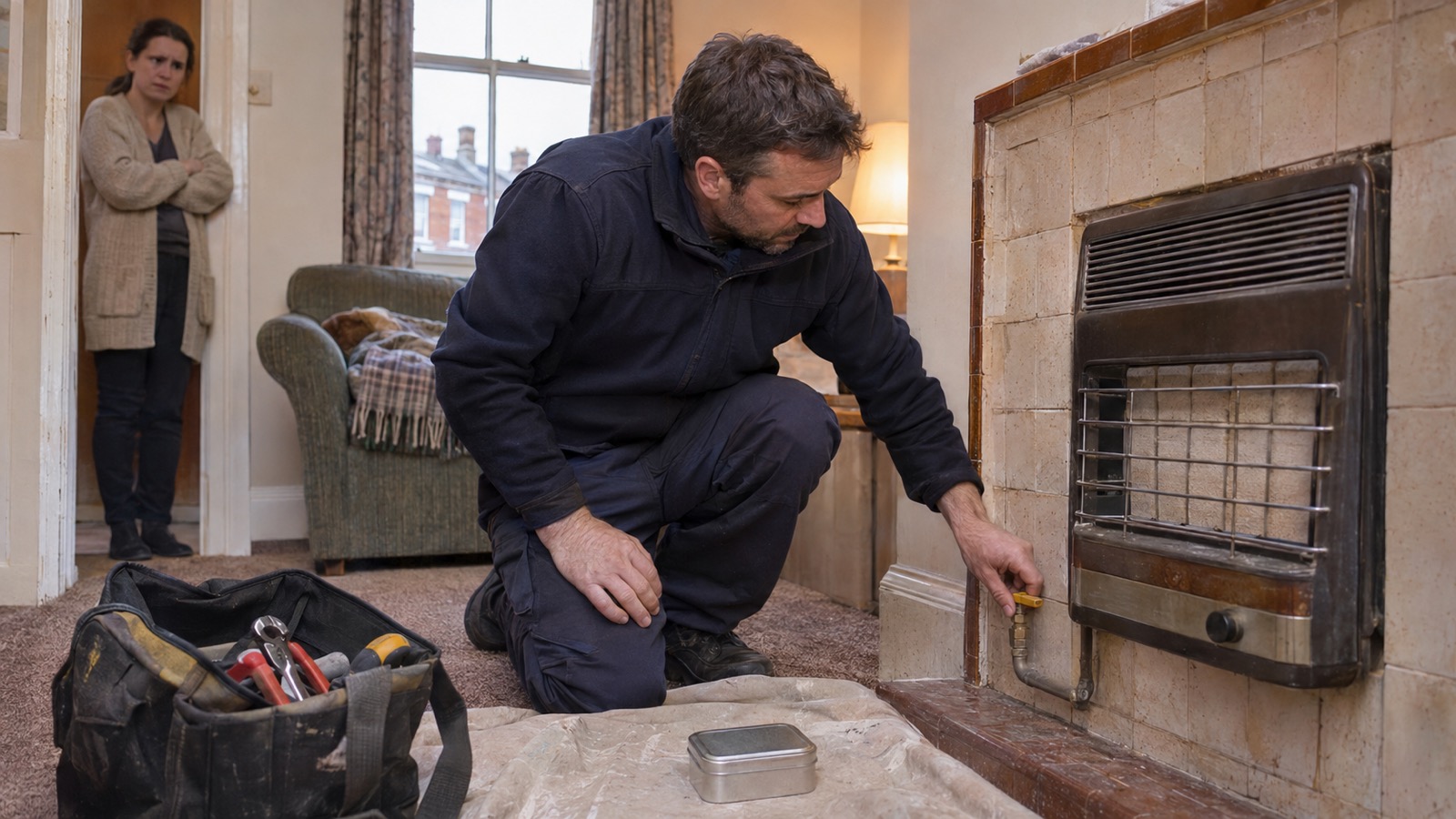
The landlord record is nearly done when the living-room gas fire fails its spillage test. It's November, the tenant wants the heating on, the letting agent isn't picking up, and whatever you write in the next ten minutes is what an inspector, an insurer or a court reads if anything goes wrong later.
The answer is two documents for one visit. The landlord gas safety record (the CP12) says what you checked and what you found. The warning notice says what is unsafe, what you did about it, who you told and whether they signed. The warning notice is the one that shows what you found, what you did and who you told, so give it the same care as the certificate. A CP12 that says "fail" with no linked notice is a weak file.
Checker produces gas warning notices alongside the landlord gas safety record, signed on site and sent to the customer as a PDF.
What do Immediately Dangerous and At Risk mean on a gas safety check?
They are the only two unsafe classifications in the current Gas Industry Unsafe Situations Procedure, IGEM/G/11 Edition 2 with amendments July 2022, June 2024 and July 2025, published by IGEM in July 2025 and free to download. Every unsafe appliance you find on a landlord check goes into one of them, and the classification decides what you do next. It is written to help you meet the 1998 regulations and HSE's code of practice, L56.
- Immediately Dangerous (ID) is an appliance or installation that, left connected, is an immediate danger to life or property. Examples include gas escapes, combustion products entering the room and failed tightness or spillage tests.
- At Risk (AR) is potentially dangerous: one or more faults exist which may in future put life or property at risk. Inadequate ventilation is the procedure's example.
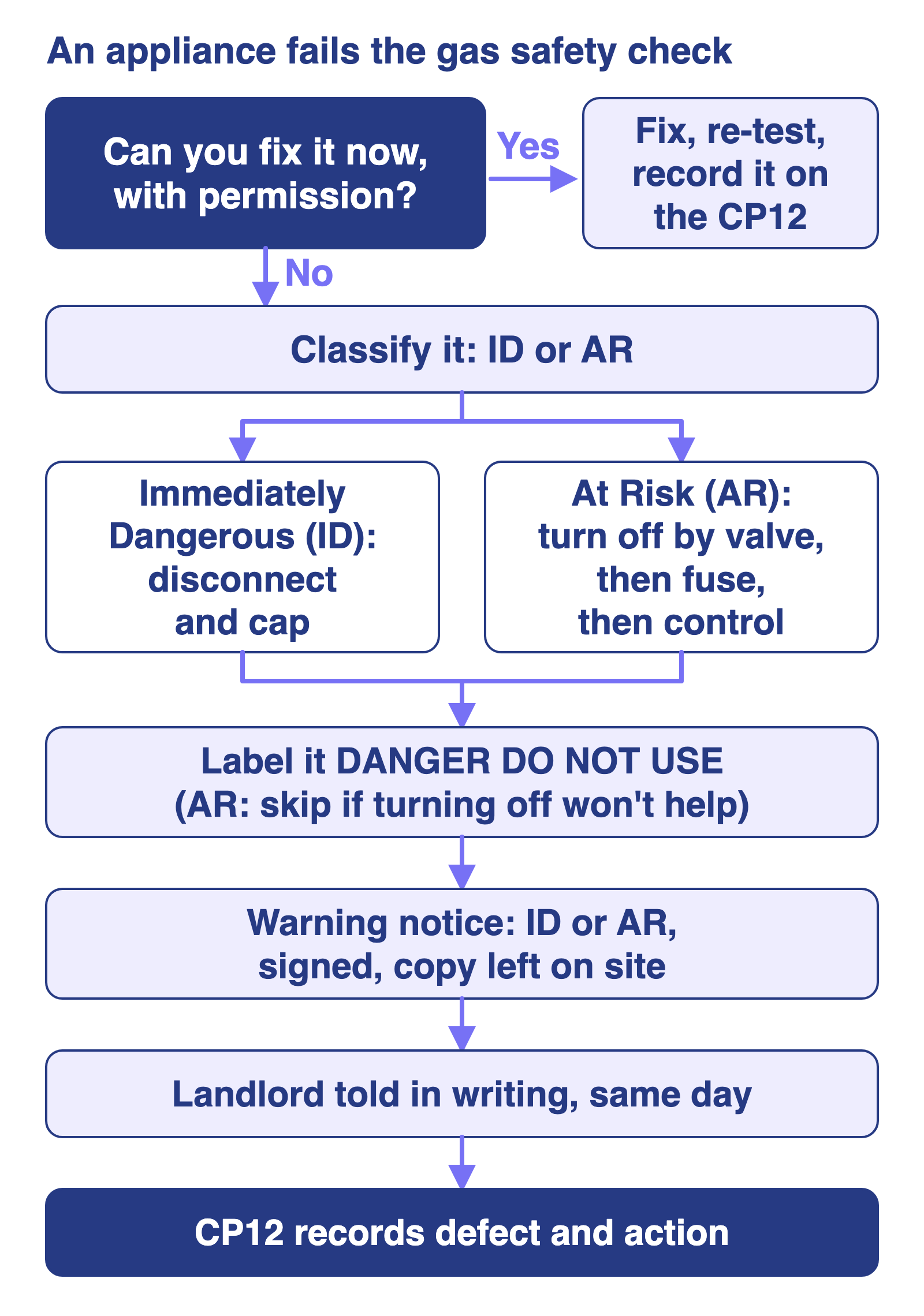
Before either label applies, the procedure expects you to try to put it right there and then, with the responsible person's agreement. A loose flue joint you can remake and re-test is a repair, recorded on the CP12 as a defect found and remedial action taken. The warning notice comes in when you cannot make it safe on that visit.
HSE says that around 7 people die every year from carbon monoxide poisoning caused by badly installed, maintained or ventilated gas appliances and flues.
What do you do on site for each classification?
The actions differ in one big way: an ID appliance comes off the gas supply, while most AR appliances are turned off.
| Situation | What you do | What goes on paper |
|---|---|---|
| Immediately Dangerous | With permission, disconnect and cap; attach a DANGER DO NOT USE label | Warning notice marked ID, signed; CP12 records the defect and action |
| At Risk, turning off removes the risk | With permission, turn off; attach the label | Warning notice marked AR, signed; CP12 records the defect and action |
| At Risk, turning off will not help | Explain why; no label; refer it on | Warning notice naming who to contact, signed if possible |
| Not unsafe | Advise the customer if you choose to | Nothing on the warning notice or safety paperwork |
Immediately Dangerous
What you do: With permission, disconnect and cap; attach a DANGER DO NOT USE label
What goes on paper: Warning notice marked ID, signed; CP12 records the defect and action
At Risk, turning off removes the risk
What you do: With permission, turn off; attach the label
What goes on paper: Warning notice marked AR, signed; CP12 records the defect and action
At Risk, turning off will not help
What you do: Explain why; no label; refer it on
What goes on paper: Warning notice naming who to contact, signed if possible
Not unsafe
What you do: Advise the customer if you choose to
What goes on paper: Nothing on the warning notice or safety paperwork
For AR, the order matters: isolation valve first, then the electrical fuse, then the appliance control, which is where the label goes. A room thermostat or clock doesn't count, and an appliance in a cupboard needs a second label on the door.
What if the tenant or landlord won't let you make it safe?
You cannot force a disconnection, but refusal changes what you do and what you write. Under regulation 34 of the Gas Safety (Installation and Use) Regulations 1998, anyone working on gas who suspects an appliance is dangerous must take all reasonably practicable steps to tell the responsible person straight away and, where different, the owner. The same regulation bars the responsible person from using, or letting anyone use, an appliance they know or suspect is dangerous.
For an Immediately Dangerous appliance on natural gas, IGEM/G/11 says that if the responsible person refuses disconnection you should still try to turn it off, then call the Gas Emergency Contact Centre on 0800 111 999 straight away. Get the job reference number and note the time of the call. The procedure notes that the emergency service will attend an ID situation within an hour and that you should stay nearby to explain the risk where you reasonably can. For LPG, the call goes to the gas supplier instead.
For an At Risk appliance, record a refusal to turn off on the warning notice, along with a refusal to sign. When nobody is home, the procedure recommends disconnecting an ID appliance or turning off an AR one, labelling it and leaving a copy of the notice on site.
Does a failed appliance need a RIDDOR report?
Only some do. Regulation 11(2) of RIDDOR 2013 makes a Gas Safe registered business report a gas fitting within 14 days when its design, construction, installation, modification or servicing has caused, or is likely to cause, death, loss of consciousness or a hospital visit through gas leaking, incomplete combustion or poor removal of combustion products.
The test is about workmanship and design. IGEM/G/11 is clear that a fitting that is dangerous through lack of maintenance is not reportable under RIDDOR, even in rented property, though you can send HSE the details as a concern. A gas fire failing because a chimney was never swept is a maintenance failure; a gas fire fitted to a flue that was never suitable for it may be reportable. If you repair a dangerous fitting on the spot, the report is still due.
What should the landlord gas safety record and the warning notice each show?
The CP12 and the warning notice cover the same visit, so each should point to the other. The law sets the landlord record's contents. Regulation 36(3)(c) lists nine items, two of which matter here: any safety defect identified and any remedial action taken. HSE adds that the record should be issued when the checks are finished, even if concerns were found and before any remedial work is done. It calls it a "living document" that the landlord adds follow-up records to, and its guidance on defects found during a check puts the duty to act on the landlord.
The warning notice has its own list. Appendix 6 of IGEM/G/11 sets out 14 minimum items:
- The gas user's name and address
- The landlord or responsible person's name and address, where appropriate
- The date the notice was issued
- Details and location of the appliance or installation, and what is unsafe
- The category applied, ID or AR
- All actions taken, including any third parties notified
- What needs to be done to put it right
- Any RIDDOR situation identified and reported
- The engineer's name and identifier
- The issuing company's name, registration number and contact details
- Contact details for the gas emergency service
- Contact details for Gas Safe Register
- A definition of the unsafe categories
- Space for the gas user's signature
The cross-references are what hold the file together. On the CP12, the gas fire line reads something like fails spillage test, ID, disconnected and capped, warning notice issued. On the warning notice, the same appliance, the same location and the same date appear, with the emergency service reference if there was one. Anyone reading either document later can find the other.
Keep both for longer than the law asks. Regulation 36 only requires the landlord's record to be kept until two further checks have been done, roughly 24 months. IGEM/G/11 advises keeping records for at least 6 years in case of civil claims.
When is a defect not a warning notice?
Some things you see on a landlord check are worth mentioning but have no place on a warning notice. The old Not to Current Standards category was taken out of the unsafe situations procedure at Edition 7. Gas Safe Register's 2019 reminder explains that an NCS situation is, by its nature, not unsafe, so it has no place in an unsafe situations procedure.
You can still tell the landlord an installation would not be fitted that way today. Gas Safe Register's guidance is that this advice should not be recorded on warning notices or on safety-related paperwork, so the real danger messages stay clear.
Over-classifying costs you: a landlord who gets AR notices for merely dated work stops reading them, including the one that matters. Some problems also have their own route: where you cannot confirm the main equipotential bonding is in place, IGEM/G/11 points to a written bonding notice under BS 6891, which asks for an electrically competent person to check it.
Who gets the warning notice, and how do you prove it?
Three copies matter, and the procedure is specific about each. The gas user signs the notice as a record of receipt and understanding and gets a copy before you leave site. You keep a copy. Where the user is not the owner, as with every tenancy, you also give the owner details of the unsafe situation in writing, which means the landlord or the managing agent.
The written notice to the landlord is the step most easily missed: the tenant has a signed copy, and the landlord hears weeks later. Send it the same day, by a route that leaves a timestamp.
The landlord still has their own duty to give the tenant a copy of the CP12 within 28 days of the check, under regulation 36(6), and GOV.UK tells tenants to expect it. For how to send the record and keep proof of delivery, see our guide to sending a gas safety record to a landlord or tenant. If you could not get in at all, that is a different record again, covered in when the tenant won't let you in.
Where does Checker fit?
Gas warning notices are one of the gas reports we build into Checker, next to the landlord gas safety record, service records and breakdown reports. You record an At Risk or Immediately Dangerous situation, get it signed on your phone or tablet on site, and send the customer a PDF with your logo. It works without signal and syncs later, which helps when the failed appliance is in a basement flat.
Each CP12 is saved against the property, so next year's visit starts from this year's record. If you run a team on PRO+, the admin can lock defect classifications, warning notice wording and certificate wording so sub users cannot edit the templated text or skip fields. Plans are £10.99 a month on LITE, £19.99 on PRO and £25.99 on PRO+, with sub users at £10.99 each, all plus VAT; see pricing and staff management.
There are limits. Checker helps you produce and store the records; it doesn't submit anything to Gas Safe Register, and it doesn't make a RIDDOR report for you. You still report through HSE yourself.
And if you're a sole trader who finds an unsafe appliance a few times a year and already carries a pad of warning notices, IGEM/G/11 accepts any format, so a paper notice carrying the 14 minimum items meets the procedure as well as a digital one. The full list of gas reports is on our plumbing and heating page.
Frequently asked questions
Is a warning notice a legal requirement?
Not as a named form. Regulations 26(9) and 34 of the Gas Safety (Installation and Use) Regulations 1998 require you to tell the responsible person and, where different, the owner when you find a dangerous appliance. IGEM/G/11, the industry procedure HSE supports, calls for a signed warning notice with 14 minimum items, so treat it as required.
Does the same procedure apply on a homeowner's job?
Yes. IGEM/G/11 covers all domestic premises, so the classification, label and warning notice are the same. There is no landlord record or landlord copy, and a homeowner is both user and owner, so their signed copy covers both.
Who repairs the appliance after a warning notice?
The landlord must keep gas fittings and flues safe under regulation 36(2) and use a Gas Safe registered engineer for the work. That can be you or another business. HSE says the landlord adds the follow-up record to the gas safety record.
Do I put a DANGER DO NOT USE label on every At Risk appliance?
No. Where turning off will not remove the risk, such as a building over a polyethylene gas service pipe, the procedure says not to attach a label. You complete a warning notice naming who the responsible person should contact instead.
On site: classify, act, label, record, deliver, file
- Classify. Decide whether it is ID, AR or a repair you can finish now.
- Make it safe. With permission, disconnect and cap an ID appliance; turn off an AR one in the right order.
- Label. Fix a DANGER DO NOT USE label where the procedure calls for one.
- Record. Put the defect and action on the CP12 and complete a warning notice with all 14 minimum items.
- Deliver. Get the signature, leave a copy, and write to the landlord or agent the same day.
- File. Keep both documents together for at least 6 years, and make any RIDDOR report within 14 days.
Warning notices, landlord records and invoices from one app on your phone.
Further reading
Authoritative sources
- IGEM/G/11 Edition 2 with amendments July 2022, June 2024 and July 2025: Gas Industry Unsafe Situations Procedure
- Gas Safety (Installation and Use) Regulations 1998, regulation 26
- Gas Safety (Installation and Use) Regulations 1998, regulation 34: use of dangerous gas appliances
- Gas Safety (Installation and Use) Regulations 1998, regulation 36: duties of landlords
- RIDDOR 2013, regulation 11: incidents and dangerous occurrences arising out of gas
- HSE: gas safety record, what it must contain and when to issue it
- HSE: landlord gas safety checks, what if defects are found
- HSE: carbon monoxide awareness and the National Gas Emergency number
- HSE: tell us about a health and safety issue
- Registered Gas Engineer: Not to Current Standards, a reminder from Gas Safe Register
- GOV.UK: your landlord's safety responsibilities
- HSE L56 (fifth edition): Safety in the installation and use of gas systems and appliances
- Checker: plumbing and heating software, including gas warning notices
- Checker: staff management and admin lockdown
- Checker pricing