
How Should a Gas Engineer Quote and Invoice a Boiler Breakdown? Call-Out, Waiting Parts and the Return Visit (UK, 2026)
Agree the call-out before you travel, mark each repair line firm, provisional or excluded, confirm a waiting part price in one dated message, then invoice from the accepted quote.
Updated 23 November 2026
TLDR: Agree the call-out charge before you travel. After diagnosis, quote the repair in writing and mark each line firm, provisional or excluded, saying who prices a waiting part and by when. Confirm that price in one dated message before fitting, then build the invoice from the accepted quote, line for line.
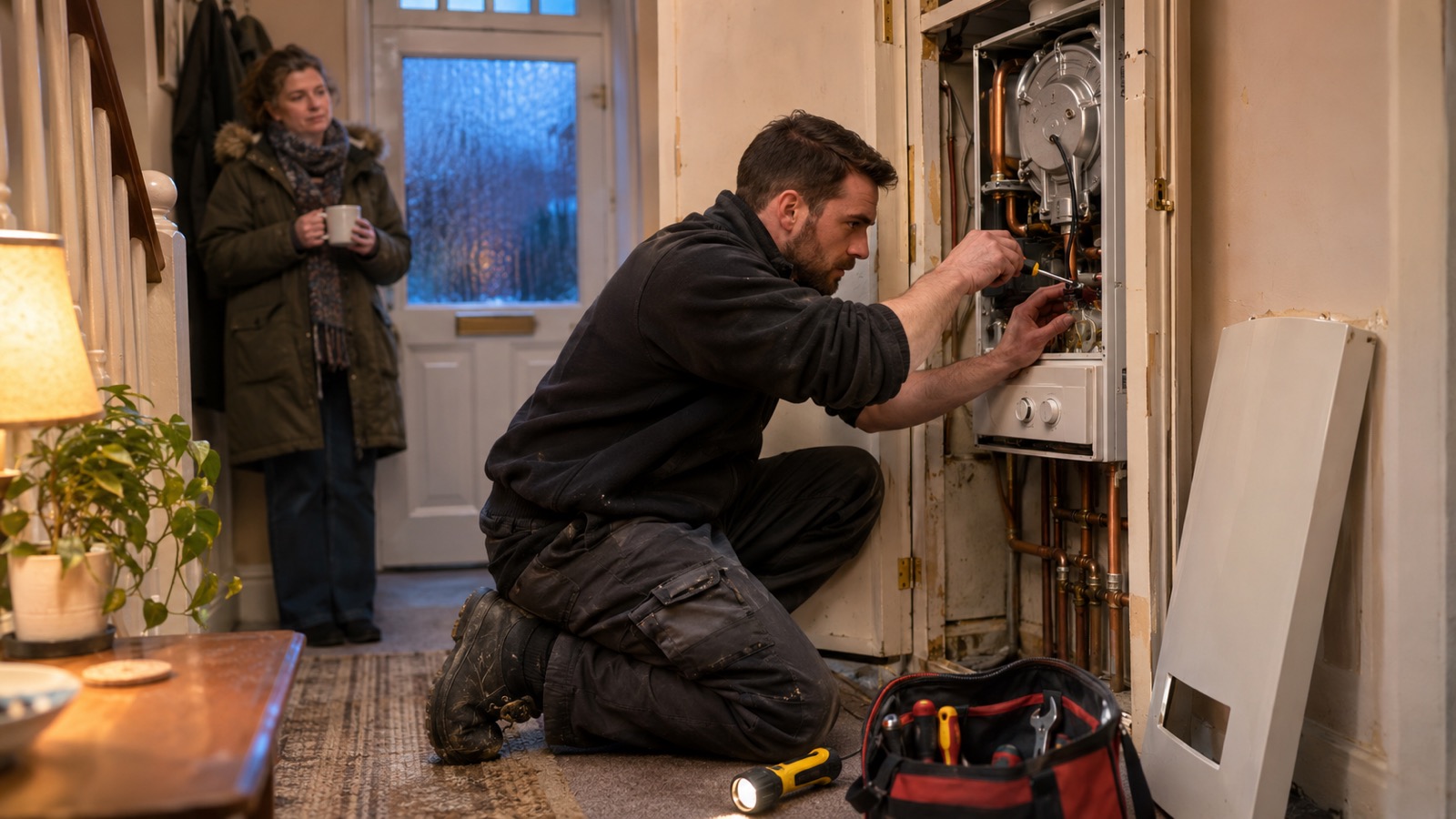
It is the first cold week of the season. The radiators are cold, you have traced the fault to the diverter valve, the merchant will not price the part until the morning, and the homeowner wants their heating back tonight.
A breakdown dispute often starts with how the price was worded. An engineer who writes valve price from the merchant by 10am tomorrow and later sends valve confirmed at £121 gets paid. An engineer who writes approx and fits the part anyway is lending the customer money until they agree what approx meant.
Breakdown record, quote and invoice on the same job, with a card link on the invoice. Get Started Free
Jump to:
- What should you tell the customer before you travel?
- Why record the diagnosis before you price the repair?
- How do you price a part you are still waiting on?
- How do you turn the accepted quote into the invoice?
- When is a call-out quote unnecessary?
- How do you get paid on the day?
- Where does Checker fit?
- A four-line call-out script
- Frequently asked questions
What should you tell the customer before you travel?
Tell them the call-out charge, what it covers and how the repair will be priced, before you set off, and send it in a text or email the same call. A homeowner who knows that £80 buys the visit and the first 45 minutes of fault-finding has little to argue about when that line appears on the invoice.
The law points the same way. Schedule 2 of the Consumer Contracts Regulations 2013 lists what a consumer must be told before they are bound, including the total price with taxes or, where it cannot reasonably be worked out in advance, the way it will be calculated. A breakdown is exactly that second case, so your booking message carries the method:
- The call-out: a fixed charge, and how much diagnosis time it includes.
- Further labour: your hourly or fixed rate once the included time runs out.
- Parts: how you price them, for example the merchant's price plus a stated percentage.
- Before any repair: that you will quote it, and wait for a yes, before you start.
Does the 14-day cancellation right stop you starting tonight?
Often not, where the homeowner specifically asked you out for an urgent repair; whether it counts as urgent is a question of fact. In that case regulation 28 removes the usual 14-day right to cancel, but not for extra services, or for goods beyond the replacement parts the repair needs, that you supply on the same visit. A magnetic filter or a system flush you suggest while you are there falls back under the normal rules. Our guide to whether an emailed quote is a contract covers the express request you need before starting that kind of work inside the cancellation period.
Why record the diagnosis before you price the repair?
Because the diagnosis is what the customer is paying the call-out for, and the repair quote only makes sense against it. Write the fault down first: what you tested, what you found, what you left the appliance doing and what still needs fixing, with photos. Then price the repair from that record.
That order protects you in two ways. If the customer declines the repair, the call-out still stands on a record they can read, with nothing left as your word against theirs. If they accept, the quote's first line can point back to the fault you recorded, so the repair and the diagnosis tell one story.
It also keeps the safety side tidy. After any work on a gas appliance, regulation 26(9) of the Gas Safety (Installation and Use) Regulations 1998 (Great Britain) requires the person who did it to examine the flue, the combustion air supply, the operating pressure or heat input and the appliance's safe functioning. A breakdown record written on site captures those checks while they are fresh, on the same job the quote and invoice will hang from.
How do you price a part you are still waiting on?
Split the quote into three kinds of line and label each one in words: firm, provisional and excluded. A firm line is a price you will charge. A provisional line names the item, the person pricing it and the time you will have the price. An excluded line says plainly that the work is not in this quote.
| Line type | Wording that works | Why it holds |
|---|---|---|
| Firm | Return visit to fit, test and record: £70 | A fixed sum the customer agreed before work |
| Provisional | Diverter valve: merchant price plus 10%, price by 10am tomorrow | Names who prices it, the method and when |
| Excluded | System flush: excluded, quoted separately if needed | The word excluded leaves no room for doubt |
Line type: Firm
Wording that works: Return visit to fit, test and record: £70
Why it holds: A fixed sum the customer agreed before work
Line type: Provisional
Wording that works: Diverter valve: merchant price plus 10%, price by 10am tomorrow
Why it holds: Names who prices it, the method and when
Line type: Excluded
Wording that works: System flush: excluded, quoted separately if needed
Why it holds: The word excluded leaves no room for doubt
The Schmitdy On Site film Tradesmen Getting Paid: One Quote Email, Six Years, One High Court Appeal makes the same point from a court case: if an item is only waiting on a price, say who the price is coming from and by when, and when a rough price becomes firm, send one dated line that says so.
That dated line is easy to skip. When the merchant comes back with £110, send the customer the confirmed price before you fit anything: Diverter valve confirmed at £121 (merchant £110 plus 10%), 22 November 2026. Reply yes and we will fit it at 2pm. Under section 50 of the Consumer Rights Act 2015, what you tell a consumer about the service becomes part of the contract when they take it into account in deciding, and a change to the required pre-contract information only counts if both of you expressly agree it. A dated message with a reply is good evidence of that agreement.
How do you turn the accepted quote into the invoice?
Build the invoice from the accepted quote, line for line, and show the confirmed price as its own line with the same wording. The customer then pays against words they have already agreed. GOV.UK's invoice checklist still applies: a unique number, your details, the customer's name and address, a clear description, the supply date, the invoice date and the total owed.
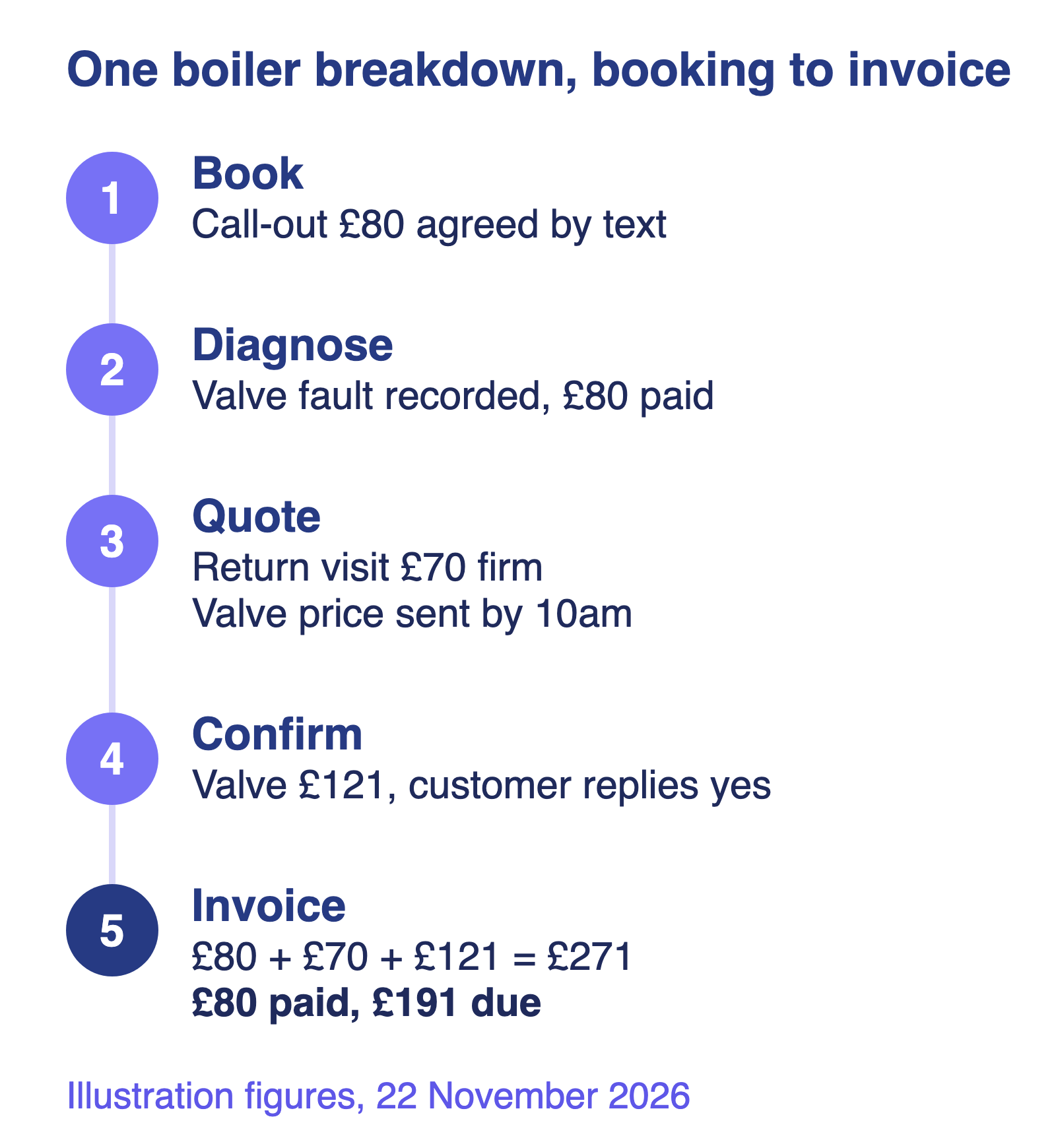
Worked example: one breakdown, booking to invoice
Here is one breakdown from booking to invoice. The engineer is a sole trader who is not VAT registered, so no VAT is added. Every figure is our own illustration, set on 22 November 2026.
| Step | What the customer sees | Money |
|---|---|---|
| 1. Booking | Text: call-out £80 with 45 minutes of diagnosis; repairs quoted first | £80 firm |
| 2. Diagnosis | Breakdown record: diverter valve faulty, photos, work still needed | £80 paid by card |
| 3. Repair quote | Return visit £70 firm; valve at merchant price plus 10%, by 10am; flush excluded | £70 plus valve |
| 4. Price confirmed | Dated message: valve £121 (merchant £110 plus 10%); customer replies yes | Valve £121 |
| 5. Invoice | Call-out £80 (paid), return visit £70, valve £121 | £271 total, £191 due |
Step: 1. Booking
What the customer sees: Text: call-out £80 with 45 minutes of diagnosis; repairs quoted first
Money: £80 firm
Step: 2. Diagnosis
What the customer sees: Breakdown record: diverter valve faulty, photos, work still needed
Money: £80 paid by card
Step: 3. Repair quote
What the customer sees: Return visit £70 firm; valve at merchant price plus 10%, by 10am; flush excluded
Money: £70 plus valve
Step: 4. Price confirmed
What the customer sees: Dated message: valve £121 (merchant £110 plus 10%); customer replies yes
Money: Valve £121
Step: 5. Invoice
What the customer sees: Call-out £80 (paid), return visit £70, valve £121
Money: £271 total, £191 due
The arithmetic is short: £80 plus £70 plus £121 is £271, and with the call-out already paid on the doorstep, £191 is left to collect. Each invoice line matches a quote line or the dated confirmation, so the customer has no new line to query. Our guide to turning a trade quote into an invoice without retyping covers what happens when a job changes partway through.
When is a call-out quote unnecessary?
When someone else has already fixed the price. A landlord or letting agent with an agreed rate card has set your call-out, labour and parts terms in advance, so you quote only what falls outside the card. Fixed-price repair offers and boiler cover plans move the risk in another way: the customer pays a known sum and you, or the provider, carry the cost of a dear part.
Those routes still need the breakdown record and an invoice that matches the agreed rate. What they remove is the provisional line, because the price was settled before the boiler failed. If most of your winter work comes through a cover provider's own job and billing system, that system sets the paperwork, and a separate quote stage adds little.
How do you get paid on the day?
Take the call-out before you leave, then send the balance with a card link the moment the return visit is done. A homeowner with the heating back on may well settle there and then, so make paying one tap.
- On the doorstep: a chip-and-pin reader for the call-out or the full bill.
- By link: a pay-now link on the invoice for a customer who is out at work.
- The cost: Stripe's published rate for standard UK cards is 1.5% plus 20p, checked on 22 November 2026 (premium cards cost more, and Zettle reader fees differ), so the £191 balance costs about £3.07 to collect.
- If they still do not pay: dated reminders, polite first, then firmer.
Our guide to taking card payments on site compares readers and links, and our guide to chasing overdue trade invoices covers the reminder sequence and when to stop chasing and start talking.
Where does Checker fit?
Checker keeps the breakdown record, the quote and the invoice on the same job, which is the whole method above. You fill in the gas breakdown and fault report on site with photos, recording what you found, what you fixed and what still needs doing. The quote goes out as a branded PDF with line items, your terms and an Accept button the customer taps, and Checker tells you when they have accepted.
For the waiting part, send the confirmed price as a dated message the customer replies to, and put the figure on the quote or invoice as its own line. When the return visit is done, open the accepted quote and tap Convert to Invoice: line items, customer, VAT setup and terms copy across, so the invoice says what the customer agreed. Add a Stripe pay-now link, or take the money on a Zettle chip-and-pin reader on the doorstep; our quotes and invoices page shows both.
Our Lite plan, at £10.99 a month plus VAT, covers reports, quotes, invoices, job sheets and Zettle card payments. It has no customer database, reminders or accounts sync; those come with Pro at £19.99 and Pro+ at £25.99, both plus VAT, and two-way Xero sync is on Pro and Pro+ only. If your breakdowns all run through a cover provider's own system, you may not need our quote stage at all.
A four-line call-out script
- Book: State the call-out charge, the diagnosis time it includes and how parts are priced, then send it in writing.
- Diagnose: Record the fault, your checks and what still needs doing before you price anything.
- Quote with dates: Mark each line firm, provisional or excluded, and say who prices any part and by when.
- Invoice from the quote: Confirm the part price in one dated message, then copy the accepted lines onto the invoice.
Run your next breakdown from booking to paid invoice on one job. Get Started Free
Frequently asked questions
Can a homeowner cancel a breakdown repair after you have done it?
If they specifically asked you to visit for urgent repairs, regulation 28 of the Consumer Contracts Regulations 2013 removes the 14-day cancellation right for that repair and the replacement parts it needs. Extra services or other goods you supply on the same visit keep the normal cancellation rules.
What can I charge if no price was ever agreed?
Under section 51 of the Consumer Rights Act 2015, where a contract fixes no price and gives no way of fixing one, the consumer must pay a reasonable price and no more. What is reasonable is a question of fact, so a written price agreed in advance is far safer.
Should I quote homeowners prices with VAT included?
Yes, if you are VAT registered. Schedule 2 of the Consumer Contracts Regulations asks for the total price inclusive of taxes, or the way it will be calculated. Quoting £100 plus VAT to a homeowner invites a dispute over £20.
Can I charge a homeowner who cancels the return visit?
Business Companion, the trading standards guidance site for England and Wales, says that when a customer misses a booking, a trader can only charge to cover their losses. If you fill the slot with other paid work there may be no loss; if the time is wasted, a charge can be made, less any savings such as a part you can return.
Does the cancellation paperwork apply to a small call-out?
Not to an off-premises contract where the consumer pays £42 or less: regulations 7(4) and 27(3) take those outside the information and cancellation rules. Citizens Advice gives a £42 threshold. A phone booking is a distance contract, which has no such threshold.
Authoritative sources
- Checker: quotes and invoices
- Checker: plumbing and heating software, UK (gas breakdown and fault reports)
- Checker pricing
- Consumer Contracts Regulations 2013, Schedule 2: information for distance and off-premises contracts
- Consumer Contracts Regulations 2013, regulation 7: scope and the £42 off-premises threshold
- Consumer Contracts Regulations 2013, regulation 27: scope of the cancellation rules
- Consumer Contracts Regulations 2013, regulation 28: exceptions, including urgent repairs
- Consumer Rights Act 2015, section 50: information about the service to be binding
- Consumer Rights Act 2015, section 51: reasonable price to be paid for a service
- Gas Safety (Installation and Use) Regulations 1998, regulation 26: gas appliances, safety precautions
- GOV.UK: invoices, what they must include
- Business Companion: supplying services
- Citizens Advice: cancelling a service you have arranged
- Stripe UK pricing, checked 22 November 2026
- Video: Tradesmen Getting Paid: One Quote Email, Six Years, One High Court Appeal, Schmitdy On Site, YouTube